

A water leak doesn’t wait for you to notice it. It runs behind the washing machine, under the water heater, and inside the wall — sometimes for days. A smart leak detector’s whole job is to catch that moment early, when it’s still a $50 problem instead of a $15,000 one. The question most DFW homeowners ask is simple: are these gadgets actually worth it?
Short answer: for the price, the protection is hard to beat. Here’s how the two main types work, what they cost, where to put them, and whether they can lower your insurance.
Key Takeaways
- There are two types: point leak sensors (they alert you) and automatic shut-off valves (they cut the water at the main by themselves).
- The math is lopsided — a modest device setup costs a fraction of the average $15,400 water-damage claim (Insurance Information Institute, 2025).
- Many insurers offer premium discounts for installed water-monitoring or shut-off systems — ask your carrier.
- Best protection: sensors at high-risk appliances plus an automatic main shut-off, especially for homes left empty.
What Are Smart Leak Detectors and Shut-Off Valves?
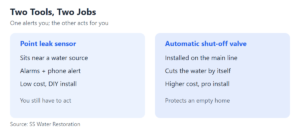
They’re two different tools for the same goal: catching a leak before it floods your home. A smart leak detector (or leak sensor) is a small, inexpensive device you place on the floor near a water source; when it senses moisture, it sounds an alarm and sends an alert to your phone. An automatic water shut-off valve is installed on your main water line and does more — it monitors flow and physically cuts off the water when it detects a leak or an abnormal, continuous flow.
The difference comes down to what happens when water appears. A sensor tells you there’s a problem so you can act. A shut-off valve acts for you — which matters most when nobody’s home to hear the alarm.
Do You Really Need One? The Risk and the Math
The numbers make the case. Water damage and freezing are the second most common home insurance claim, averaging $15,400 (Insurance Information Institute, 2025), and the failures that cause them are ordinary — a burst washing-machine hose, a leaking water heater, a cracked supply line. The Insurance Institute for Business & Home Safety points to these appliance and plumbing failures as leading drivers of interior water loss (IBHS).
Against a five-figure average claim, a handful of $20 sensors is rounding error. And the value isn’t just money — it’s time. Because mold can begin within 24 to 48 hours of materials getting wet (EPA), catching a slow leak on hour one instead of day three is the difference between drying a floor and gutting a wall. The appliances most likely to leak are exactly where these devices earn their keep — an aging water heater or a clogged AC condensate line among the most valuable to guard.
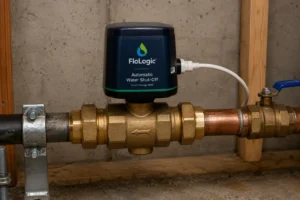
Point Sensors vs. Whole-Home Shut-Off: Which Is Right?
Match the device to the risk you’re protecting against. If you’re mostly worried about the usual suspects — the washer, the water heater, under the sinks — a set of point sensors is cheap, simple, and effective. If you travel often, own a second home, or want protection that doesn’t depend on you being there to react, an automatic main shut-off is worth the higher cost.
Most well-protected homes use both: sensors at the individual appliances for early warning, plus a shut-off valve on the main as the backstop. Think of it in tiers — a little protection is far better than none, and full protection is still cheap next to a flooded first floor.

Where Should You Place Leak Detectors?
Put them wherever a leak is most likely and most likely to go unnoticed. The highest-value spots are the appliances tied to a water line and the low, hidden areas where water collects before you’d ever see it. A sensor does nothing in the middle of a dry room — it needs to sit exactly where water would first appear.
Prioritize these locations:

Can Leak Detectors Lower Your Insurance?
Often, yes. Many home insurers offer premium discounts for installed water-monitoring systems and automatic shut-off valves, because these devices measurably reduce the size and frequency of water claims. It’s the same logic behind discounts for security systems — prevention is cheaper than payout. The exact discount varies by carrier, so the move is simple: call your insurance agent, tell them what you plan to install, and ask what it saves.
Even a modest annual discount, stacked on top of the flood you avoid, tilts the math further in favor of installing them. Just keep documentation of the devices in case you ever need to prove they were in place.
What They Can’t Do (When You Still Need a Pro)
A detector’s job ends the moment it does its job — it warns you or shuts the water. It doesn’t dry your home, and it can’t undo damage that already happened before it triggered or in a spot you didn’t cover. A sensor under the sink won’t catch a slow leak inside a second-floor wall, and a shut-off valve won’t pull moisture out of a soaked subfloor.
That’s the line where prevention ends and restoration begins. If water has already reached flooring, cabinets, or drywall, you need a pro to find the hidden moisture and dry the structure before mold sets in. That’s what water damage restoration exists for — and it pairs perfectly with the pre-trip steps in our guide to preventing water damage while you’re away.
So — Are Smart Leak Detectors Worth It?
For almost every DFW homeowner, yes. A few sensors at your highest-risk appliances cost less than dinner out and can catch a leak while it’s still trivial. Add an automatic shut-off valve if you travel or leave the house empty, and you’ve closed off the scenario that causes the worst floods.
At SS Water Restoration, we see the homes that had detection and the ones that didn’t — and the difference in the damage is dramatic. Founder Stephan Sannikov (license #RCO1659) leads an IICRC-certified team serving Collin and Denton County. Prevention is always cheaper than restoration.
Already dealing with a leak a sensor caught too late? Call SS Water Restoration 24/7 at (469) 737-0296 for a free North Texas inspection. We find hidden moisture, dry it right, and bill your insurance directly.
Frequently Asked Questions
Are smart leak detectors worth it?
For most homes, yes. A set of sensors costs a small fraction of the average $15,400 water-damage claim (Insurance Information Institute, 2025) and can catch a leak within seconds. Because mold can start in 24–48 hours (EPA), early warning is what limits the damage.
What’s the difference between a leak sensor and an automatic shut-off valve?
A leak sensor detects moisture and alerts you so you can act. An automatic shut-off valve is installed on your main line and physically stops the water by itself when it detects a leak — protection that works even when no one is home to respond.
Do leak detectors lower your home insurance?
Often. Many insurers offer premium discounts for water-monitoring systems and automatic shut-off valves, since they reduce water claims. The amount varies by carrier, so ask your agent what installing them would save on your policy.
Where should I put water leak detectors?
At your highest-risk spots: behind the washing machine, at the water heater base, under sinks, behind the refrigerator, near the dishwasher and toilet, and at the sump pump or lowest floor drain. Place them where water would first appear, not in the open middle of a room.
Do I still need a professional if I have leak detectors?
Yes, once water has already caused damage. Detectors prevent and warn; they don’t dry your home or reach moisture hidden in walls and subfloors. Any water that reached flooring, cabinets, or drywall should be dried by a pro before mold takes hold.
The Bottom Line for North Texas Homeowners
Water detection is one of the cheapest, highest-return upgrades you can make. Here’s what to remember:
- Two tools: sensors that alert you, and shut-off valves that act for you.
- The cost is trivial next to the average $15,400 water claim.
- Ask your insurer about a discount for installing them.
- Detectors prevent and warn — but a pro is still what dries your home after damage.
If a leak got past you anywhere in DFW, call SS Water Restoration 24/7 at (469) 737-0296 for a free inspection.
Sources
- Insurance Information Institute, Facts + Statistics: Homeowners insurance, retrieved 2026-07-02, https://www.iii.org/fact-statistic/facts-statistics-homeowners-and-renters-insurance
- Insurance Institute for Business & Home Safety (IBHS), State of the Risk: Interior Water Damage, retrieved 2026-07-02, https://ibhs.org/interior-water/state-of-the-risk-interior-water-damage/
- U.S. Environmental Protection Agency, A Brief Guide to Mold, Moisture and Your Home, retrieved 2026-07-02, https://www.epa.gov/mold/brief-guide-mold-moisture-and-your-home