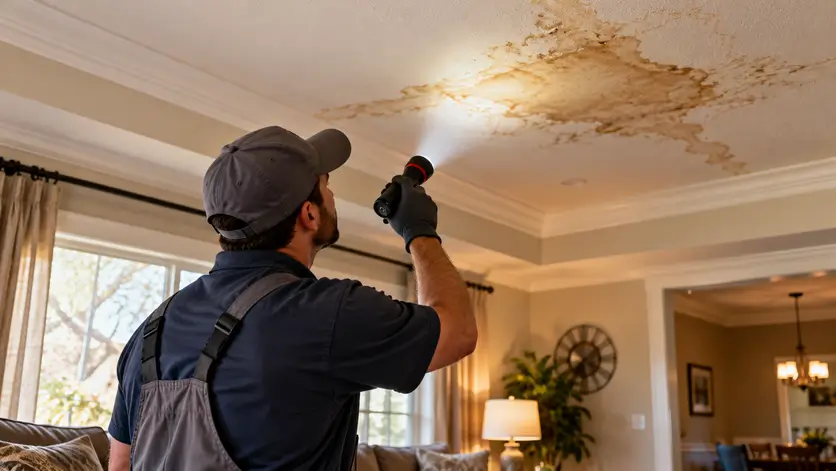


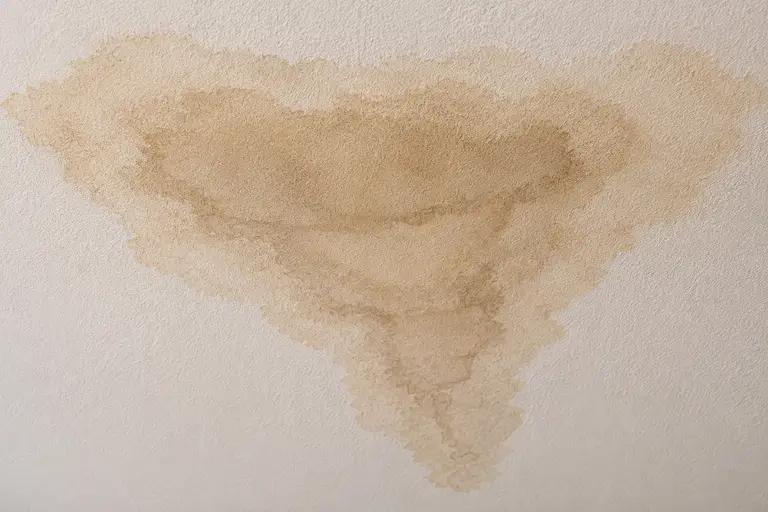
It’s a 102-degree afternoon in Frisco, the AC has run for nine hours straight, and there’s a brown ring spreading across your hallway ceiling. That stain almost always traces back to one place: your air conditioner. In North Texas, where summers are long and cooling systems run far harder than almost anywhere else in the country, a clogged condensate line is one of the most common — and most preventable — sources of home water damage we see.
This guide explains why your AC leaks, where the water goes, and exactly when a drip becomes an emergency.
Key Takeaways
- Your AC pulls humidity from the air and drains it as water; a clogged condensate line sends that water into your ceiling instead of outside.
- Mold can start growing in 24 to 48 hours after water exposure (EPA), so a slow AC leak is a real restoration risk.
- Water damage and freezing account for 22.6% of all home insurance claims, averaging $15,400 (Insurance Information Institute, 2025).
- Monthly filter changes and an annual tune-up prevent the majority of condensate clogs.
Why Does an Air Conditioner Produce Water at All?
Your AC doesn’t just cool air — it dehumidifies it, and that moisture has to go somewhere. As warm, humid Texas air passes over the cold evaporator coil, water condenses out, drips into a pan, and flows through a condensate drain line to the outside. A typical system can shed several gallons on a humid day.
That’s by design. The problem starts when the water can’t escape. The U.S. Department of Energy notes that AC maintenance of “filters, coils, and refrigerant lines” is essential for performance (Department of Energy). When any part of that drainage path clogs, the pan overflows — and gravity decides where it lands.
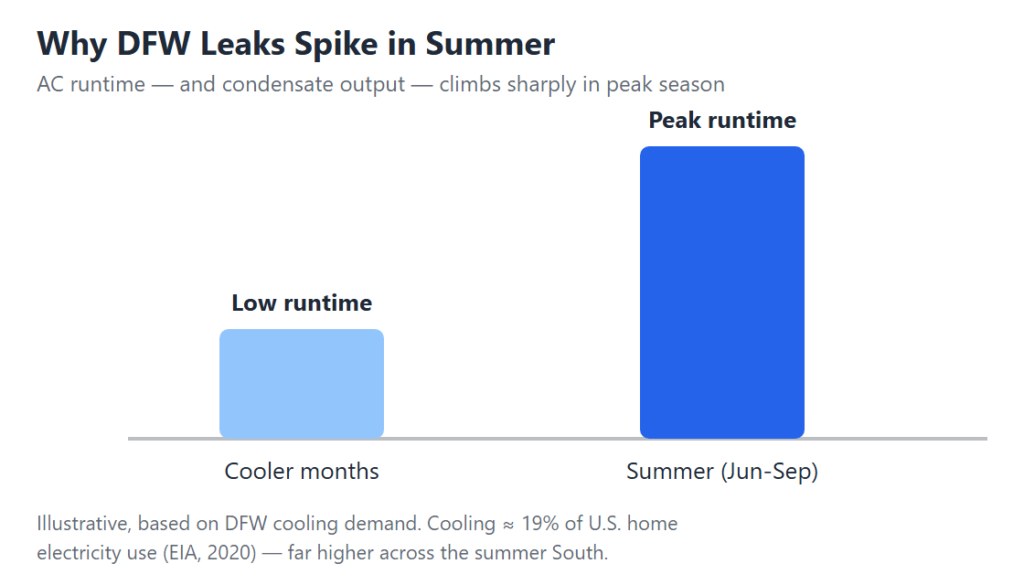
The math is simple: more runtime means more condensate. Cooling already accounts for about 19% of all U.S. home electricity use — and far more across the hot-summer South. A DFW system runs nearly nonstop from June through September, producing water the entire time. That’s why AC leaks spike in the same months DFW homeowners least expect a “water” problem.
 What we see in the field: Across North Texas, the worst ceiling damage isn’t from storms — it’s from attic air handlers quietly overflowing in July while families are at work.
Related: early warning signs of water damage most homeowners miss.
Where Does the Leak Actually Come From?
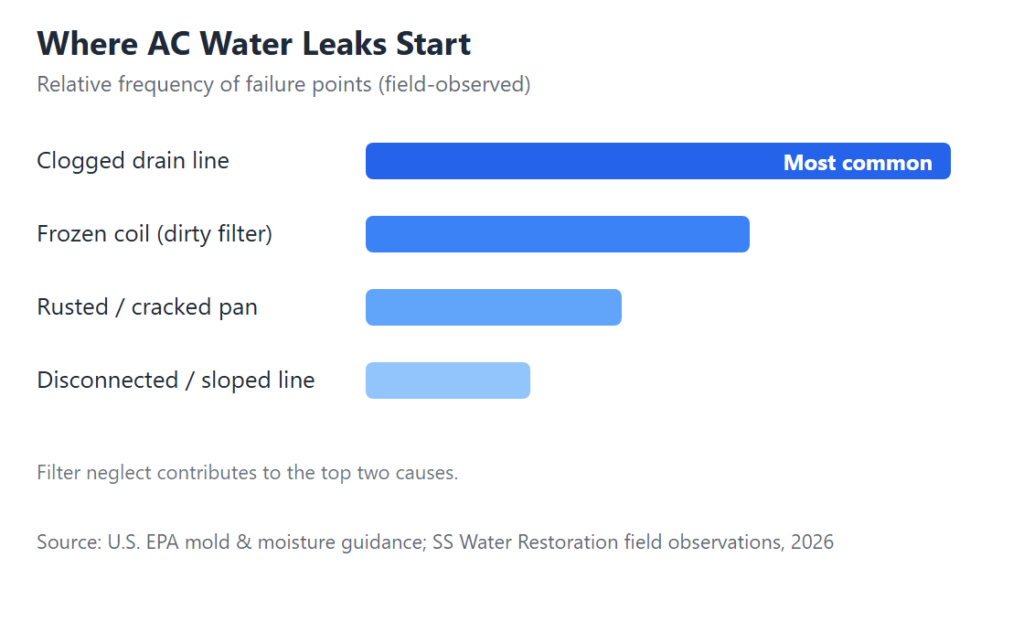
Most AC water leaks come from four failure points, and a clogged drain line is the runaway leader. The condensate line is a narrow PVC pipe — the perfect home for algae, mold, and dust sludge. The EPA specifically recommends keeping “HVAC drip pans clean, flowing properly and unobstructed” to prevent moisture problems (EPA).
Here’s where the water typically originates:
- Clogged condensate drain line — algae and biofilm block the pipe; the pan overflows.
- Rusted or cracked drain pan — older pans corrode and leak from underneath.
- Frozen evaporator coil — a dirty filter restricts airflow, the coil ices over, then melts and floods the pan.
- Disconnected or sloped line — a bumped or poorly pitched line drains backward into the house.
A dirty filter sits behind two of those four causes. ENERGY STAR recommends inspecting, cleaning, or changing your filter once a month (ENERGY STAR). Skip that, and airflow drops, the coil freezes, and you’ve got a flood waiting for the next hot afternoon.
 Related: how to identify and repair ceiling water stains before they spread.
How Bad Can an Attic Air Handler Leak Get?
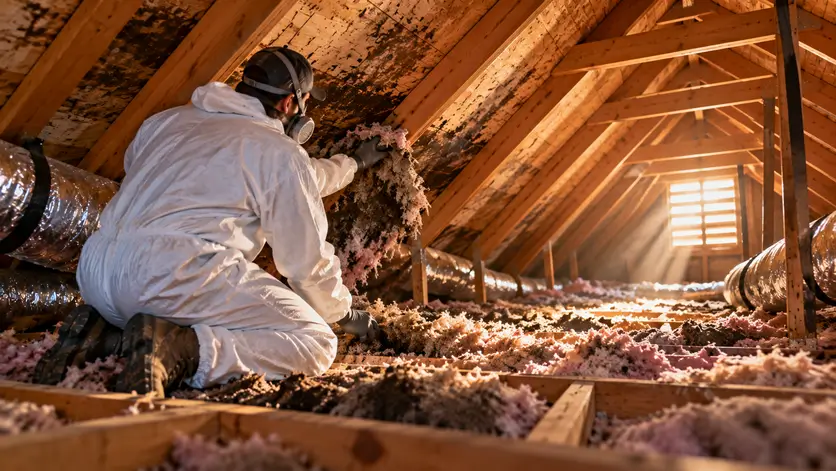
Very bad — because in most DFW homes, the air handler sits in the attic, directly above your living space. When that unit overflows, water doesn’t pool on a slab in the garage. It saturates attic insulation, soaks through drywall, and drips into bedrooms and hallways below. By the time you see a stain, the leak has usually been running for days.
The financial stakes are real. Water damage and freezing make up 22.6% of all home insurance claims, the second-most-common claim type, averaging $15,400 per claim (Insurance Information Institute, 2025). And remember the FEMA figure cited by This Old House: a single inch of water can cause up to $25,000 in damage (This Old House).
On attic-handler jobs, the pattern repeats: a homeowner patches the ceiling stain, repaints, and calls it done — without ever clearing the clog or drying the insulation. Six weeks later, we’re back for mold remediation that costs far more than the original line flush would have. 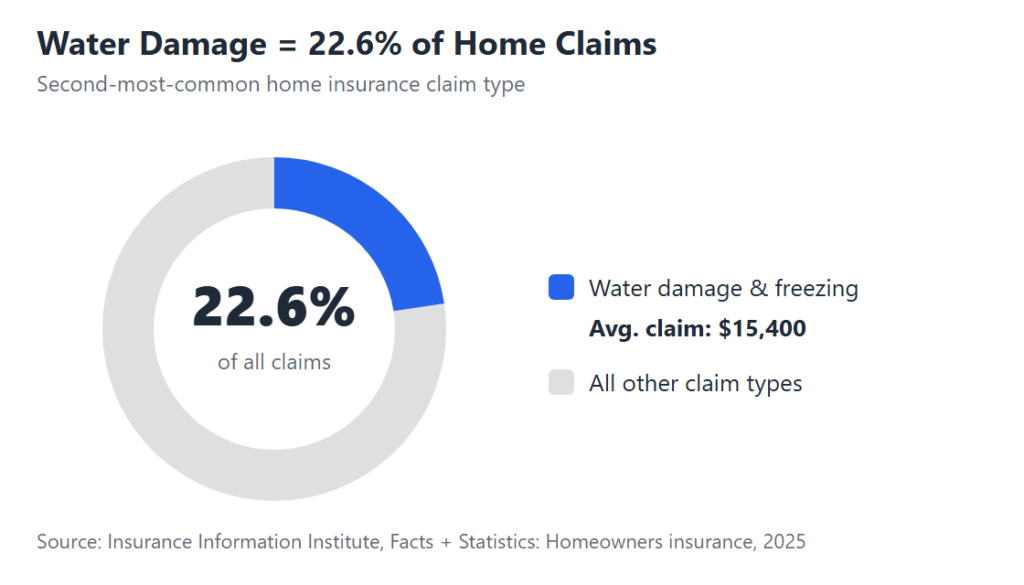 Related: our guide to filing a water damage insurance claim in Texas.
How Fast Does an AC Leak Turn Into a Mold Problem?
Faster than most homeowners expect. The EPA advises drying any water-damaged area within 24 to 48 hours to prevent mold growth (EPA). A slow condensate drip checks every box mold needs: a warm attic, organic material in the drywall and insulation, and constant moisture from a system that runs all day.
The EPA also recommends keeping indoor humidity below 60% — ideally between 30 and 50% — to discourage mold (EPA). A leaking AC quietly works against that target, pushing damp air and standing water into the very spaces you can’t see.
So why does a “small” ceiling spot matter? Because the visible stain is the last symptom, not the first. Wet insulation and framing behind it have usually been incubating mold for days before the drywall finally shows it.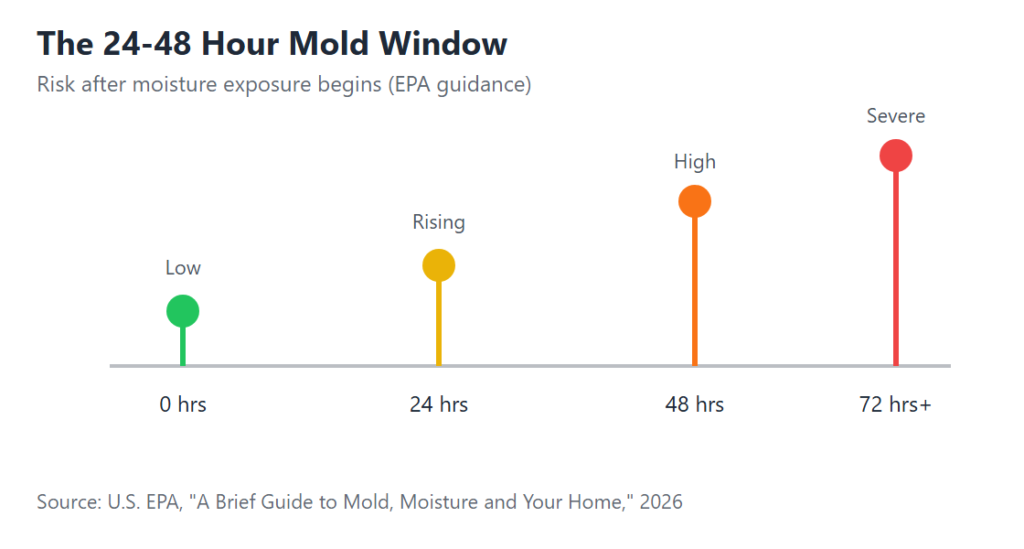
Related: how professional mold remediation stops a small leak from becoming a health hazard.
What Should You Do the Moment You Spot an AC Leak?
Act within the hour — the 24-to-48-hour mold clock starts the instant water hits drywall. Your first job is to stop the source and limit how far the water spreads, then decide whether it’s a DIY fix or a restoration call. Quick action is the single biggest factor in keeping a $200 problem from becoming a $15,000 one.
Take these steps in order:
- Turn the AC off at the thermostat. No runtime means no new condensate feeding the leak.
- Find the source. Check the attic air handler, drip pan, and the drain line’s exit point outside.
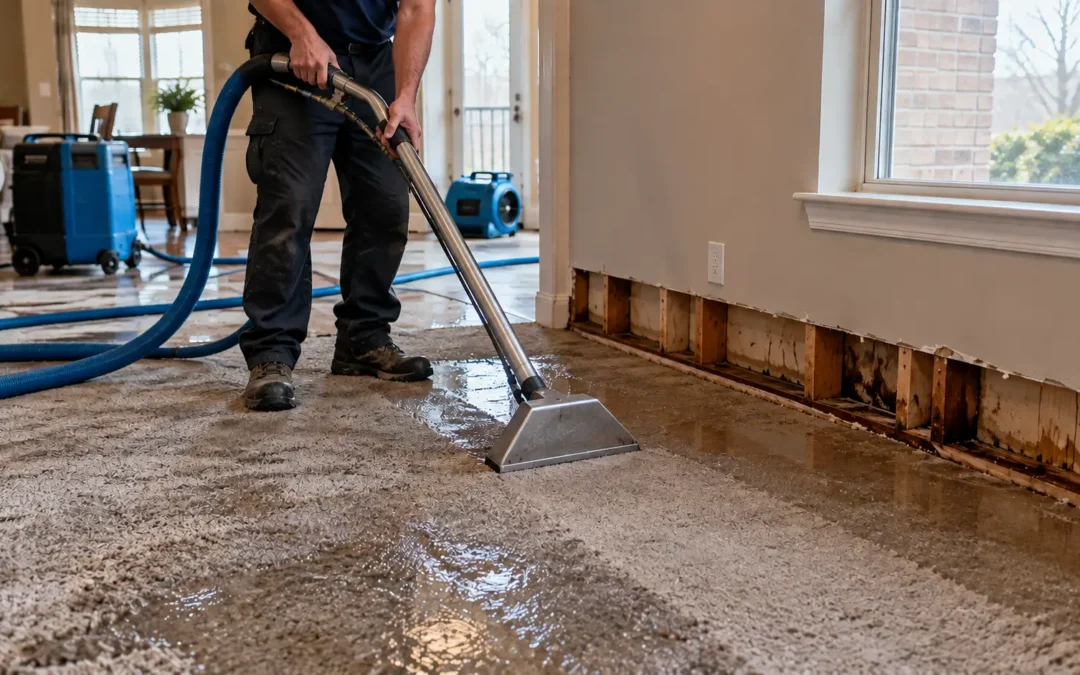
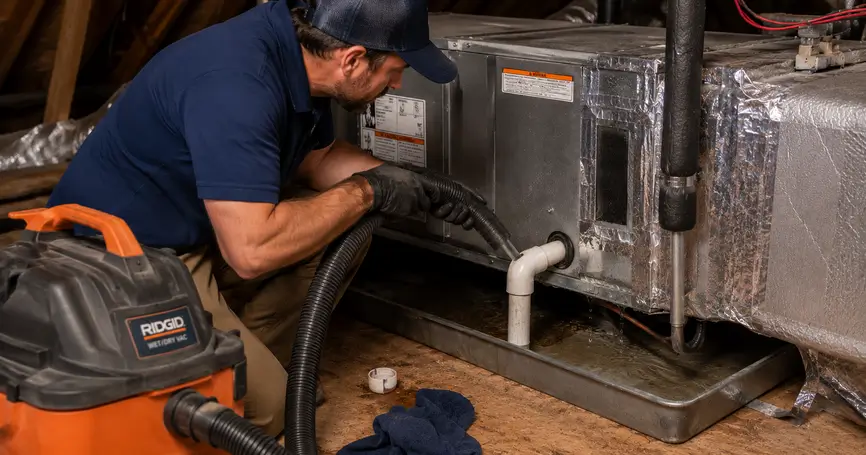
- Clear standing water. Use a wet/dry vacuum on the pan and any pooled water below.
- Check the drain line. A wet/dry vac on the outdoor end can pull a minor clog; flushing with a cup of distilled vinegar helps prevent regrowth.
- Document everything. Photograph the unit, the stain, and the water — you’ll want this for insurance.
- Assess the ceiling. Bowing, sagging, or a soft, spreading stain means water is already in the structure.
If the drywall is sagging, insulation is soaked, or the stain keeps growing, the damage has moved past a weekend fix. That’s the line between maintenance and restoration.
When Should You Call a Restoration Professional?
Call a pro the moment water has reached drywall, insulation, or framing — not just the drain pan. A plumber or HVAC tech can clear the clog, but they don’t dry the structure or test for hidden moisture. That gap is exactly where mold takes hold, and it’s why a same-day restoration assessment matters.
At SS Water Restoration, our IICRC-certified team uses moisture meters and thermal imaging to find water you can’t see, then dries the structure before mold can establish. We work directly with your insurer on water damage claims — the same category that averages $15,400 nationally (Insurance Information Institute, 2025). Founder Stephan Sannikov (license #RCO1659) leads a crew that handles AC-related water damage across Collin and Denton County year-round.
Wondering whether your stain crosses that line? When in doubt, get it inspected. A free inspection costs nothing; a hidden mold colony costs thousands.
Standing water above your ceiling right now? Call SS Water Restoration 24/7 at (469) 737-0296 for a free North Texas inspection. We respond fast, dry it right, and bill your insurance directly.
See our water damage restoration services and the DFW service area we cover.
Frequently Asked Questions
Is a leaking AC an emergency?
It can be. If water is dripping through a ceiling or pooling near electrical or framing, treat it as urgent — the EPA’s mold window is just 24 to 48 hours (EPA). Shut off the AC, clear standing water, and get an inspection before the structure stays wet.
Can I unclog my AC condensate drain line myself?
Often, yes, for a minor clog. Attach a wet/dry vacuum to the drain line’s outdoor exit to pull the blockage, then flush with distilled vinegar to slow algae regrowth. If the line clogs repeatedly or the pan keeps overflowing, an HVAC tune-up is the better fix. ENERGY STAR recommends annual professional service (ENERGY STAR).
Does homeowners insurance cover AC water damage?
Usually, sudden and accidental water damage from an AC failure is covered, while damage from long-term neglect may not be. Since water damage and freezing make up 22.6% of all home claims (Insurance Information Institute, 2025), document the source with photos and file promptly. We help DFW homeowners coordinate these claims directly.
How do I stop my AC from leaking again?
Change your filter monthly, schedule an annual AC tune-up, and pour a cup of distilled vinegar down the condensate line each season. ENERGY STAR notes that clean filters and coils keep the system draining properly. Most clogs are entirely preventable.
Why does my AC only leak on hot days?
Because runtime drives condensate. On a 100-degree DFW afternoon, your system runs for hours and produces far more water than on a mild day. Cooling makes up about 19% of U.S. home electricity use (EIA, 2020), and Southern summers push that far higher — so a marginal drain line that copes in spring overflows under peak summer load.
The Bottom Line for North Texas Homeowners
A leaking AC isn’t a quirk — it’s a water-damage event on a 24-to-48-hour clock. Here’s what to remember:
- Your AC makes gallons of water daily in summer; a clog sends it into your ceiling.
- Mold can start in 24 to 48 hours, so a slow drip is a real restoration risk.
- Monthly filters plus an annual tune-up prevent most condensate clogs.
- Once water reaches drywall or insulation, call a pro — drying the structure is what stops mold.
Don’t wait for the stain to spread. If your AC is leaking and you’re anywhere in DFW, call SS Water Restoration 24/7 at (469) 737-0296 for a free inspection.
Next read: Hidden signs of water damage homeowners often miss — and how to catch them early.
Sources
- Insurance Information Institute, Facts + Statistics: Homeowners insurance, retrieved 2026-06-29, https://www.iii.org/fact-statistic/facts-statistics-homeowners-and-renters-insurance
- U.S. Environmental Protection Agency, A Brief Guide to Mold, Moisture and Your Home, retrieved 2026-06-29, https://www.epa.gov/mold/brief-guide-mold-moisture-and-your-home
- ENERGY STAR, Maintenance Checklist, retrieved 2026-06-29, https://www.energystar.gov/saveathome/heating-cooling/maintenance-checklist
- U.S. Energy Information Administration, How much electricity is used for air conditioning in the U.S.? (cooling ≈ 19% of home electricity, 2020), retrieved 2026-06-29, https://www.eia.gov/tools/faqs/faq.php?id=1174&t=1
- This Old House, Water Damage Statistics (citing FEMA), retrieved 2026-06-29, https://www.thisoldhouse.com/foundations/water-damage-statistics