

After a flood, burst pipe, or AC leak, the clock is already running, mold can start within 24-48 hours, and you have to pick a restoration company fast, often while you’re stressed and water is still on the floor. The wrong choice can leave hidden moisture behind and turn a manageable job into a mold problem. Here are the seven things every DFW homeowner should verify before signing anything, plus the red flags that should send you looking elsewhere.
Key Takeaways
- Choose an IICRC-certified company; key credentials include WRT (Water Damage Restoration Technician) and ASD (Applied Structural Drying) (IICRC).
- Verify licensing, insurance, local presence, and 24/7 availability before hiring.
- Demand a written scope with moisture documentation, not a vague verbal quote.
- Materials left wet beyond 24-48 hours are at risk of mold, so response speed is part of the decision (EPA).
Why does choosing the right restoration company matter?
It matters because an uncertified or careless crew can leave hidden moisture behind, and materials that stay wet beyond 24-48 hours are at real risk of mold (EPA). What looks “dry” on the surface is often still wet inside walls and subfloor, where the real damage develops.
Choosing a company that isn’t properly trained can lead to incomplete restoration or further damage, because untrained technicians may use outdated methods or miss moisture entirely. The IICRC S500 standard exists precisely to define proper drying procedures (IICRC S500). You’re not just buying cleanup; you’re buying the assurance that the structure is verifiably dry.
The stakes are higher than the invoice. A botched job can mean tearing everything out again weeks later, plus a mold remediation bill you could have avoided.
1. Is the company IICRC certified?
Start here: the IICRC (Institute of Inspection, Cleaning and Restoration Certification) is the recognized standards body for this industry, and a certified company employs technicians trained and tested against its published standards. Its Water Damage Restoration Technician (WRT) certification covers water losses, sewer backflows, and contamination categories (IICRC).
Look for specific credentials. The IICRC offers stacked certifications including Water Damage Restoration (WRT), Applied Structural Drying (ASD), and Applied Microbial Remediation (AMRT) for mold (IICRC). At minimum, ask whether the technicians doing your job hold WRT and ASD, and ask to see proof. A reputable company won’t hesitate.
What licensing, insurance, and local presence should they have?
Beyond certification, three practical checks protect you: proper licensing, real insurance, and a genuine local footprint. Skip any of these and you’re exposed if something goes wrong.
Licensed and insured. The company should carry liability insurance and workers’ compensation. If a worker is hurt in your home or your property is damaged during the job, their coverage, not yours, should pay. Ask for a certificate of insurance.
Local DFW presence. A company with a real local address and an established reputation is accountable long after the trucks leave. This matters most after major storms, when out-of-state “storm chasers” flood the area, take deposits, and vanish.
24/7 emergency availability. Water damage doesn’t wait for business hours, and neither should your restoration company. Fast response is part of the job, not a luxury, given the 24-48 hour mold window.
The storm-chaser trap: After big North Texas storms, crews from out of state descend on DFW neighborhoods. They often lack local licensing, can’t be reached for warranty issues, and disappear before any mold shows up. A verifiable local address is one of your best filters.
5-7. References, written scope, and insurance billing
The final three checks separate professionals from gamblers: verifiable references, a detailed written scope, and experience billing insurance directly. Before hiring, verify current certifications, request references from recent projects, and confirm insurance coverage.
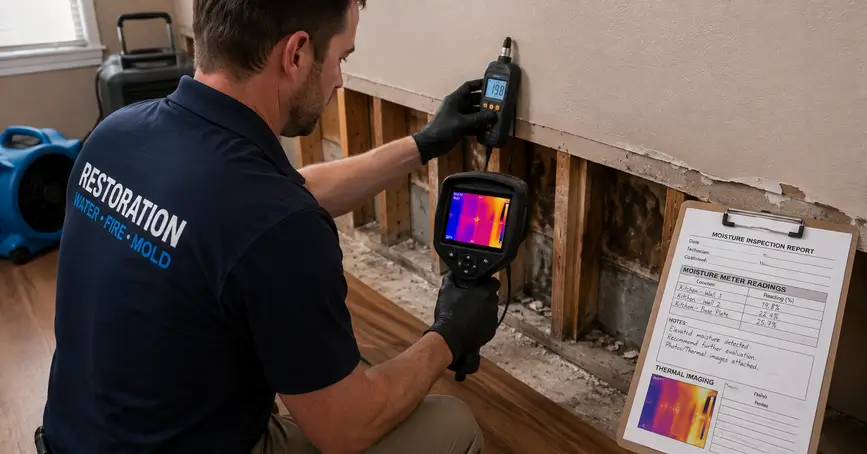
A real scope of work lists the affected areas, the equipment, the drying plan, and, crucially, moisture readings documented over time, not a number scribbled on a business card. Companies that bill your insurer directly also save you from fronting thousands and fighting for reimbursement later.
What questions should you ask before hiring?
Ask direct questions and judge the company by how readily it answers. A professional welcomes them; a fly-by-night operation deflects. Run through this short list on the phone before anyone comes out:
- Are your technicians IICRC certified, and in which categories?
- Can you provide proof of liability insurance and workers’ comp?
- Do your own employees do the work, or do you subcontract it?
- Will you document moisture readings throughout the drying process?
- Do you bill my insurance company directly?
- What’s your typical response time in my area?
What are the red flags of a bad restoration company?
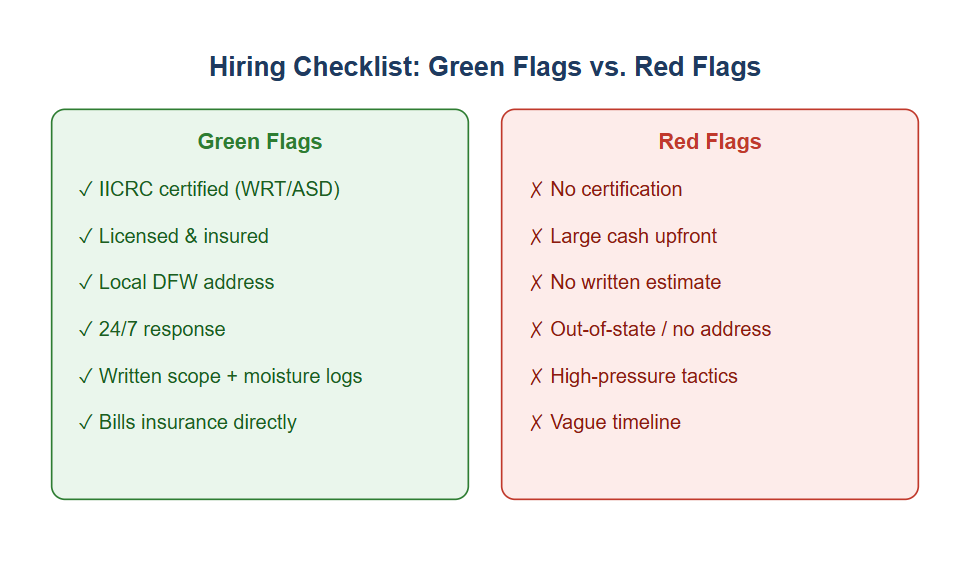
The clearest warning signs are no certification, a demand for a large cash payment upfront, and no written estimate. Any one of these is reason enough to keep looking.
Other red flags include high-pressure sales tactics (“sign now or lose your spot”), no verifiable local address, and a refusal to put the timeline or scope in writing. Trust your gut: if a company is cagey about credentials or insurance during the sales pitch, it won’t get more transparent once it has your deposit.
Frequently Asked Questions
What is IICRC certification?
IICRC certification is an industry credential earned through training and exams, requiring technicians to demonstrate competency in areas like water extraction and structural drying. Certifications such as WRT, ASD, and AMRT show a technician is trained to recognized industry standards (IICRC), and certified firms follow the IICRC S500 standard for professional water damage restoration.
Should the company bill my insurance directly?
Ideally, yes. Companies experienced with insurance billing can work directly with your adjuster, which spares you from paying thousands upfront and chasing reimbursement. Confirm this before hiring, and see our guide to water damage insurance coverage for what to expect.
How fast should a restoration company respond?
Fast, ideally 24/7 with a local crew on-site within hours. Speed isn’t a luxury here: materials left wet beyond 24-48 hours are at real risk of mold (EPA), so every hour of delay raises the risk of secondary damage.
Is the cheapest quote a good idea?
Rarely. The lowest bid often skips proper drying, moisture monitoring, or contaminated-material removal, leaving hidden moisture that turns into mold. Paying slightly more for a certified, documented job usually costs far less than redoing a cut-rate one.
Conclusion
Hiring a restoration company under pressure is hard, but a short checklist makes it manageable. Certification, licensing, insurance, local presence, references, a written scope, and direct insurance billing are the seven signals that separate a professional from a risk.
- Confirm IICRC certification (WRT and ASD at minimum).
- Verify licensing, insurance, and a real local address.
- Get a written scope with documented moisture readings.
- Watch for storm chasers, cash-upfront demands, and pressure tactics.
SS Water Restoration is IICRC-aligned, local to Dallas-Fort Worth, and available 24/7. Learn more about our team and our water damage restoration services, or request a free inspection.
Sources
- IICRC, “Water Damage Restoration Technician (WRT),” retrieved 2026-06-18, https://iicrc.org/wrt/
- IICRC, “S500 Standard for Professional Water Damage Restoration,” retrieved 2026-06-18, https://iicrc.org/s500/
- U.S. EPA, “A Brief Guide to Mold, Moisture and Your Home,” retrieved 2026-06-18, https://www.epa.gov/mold/brief-guide-mold-moisture-and-your-home