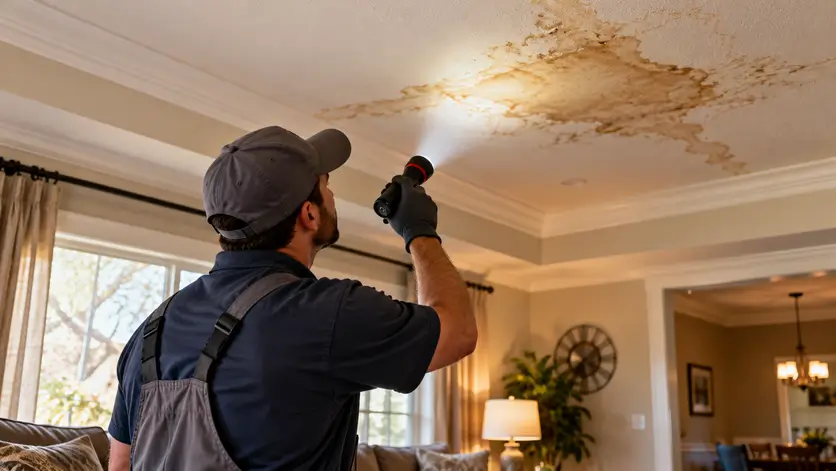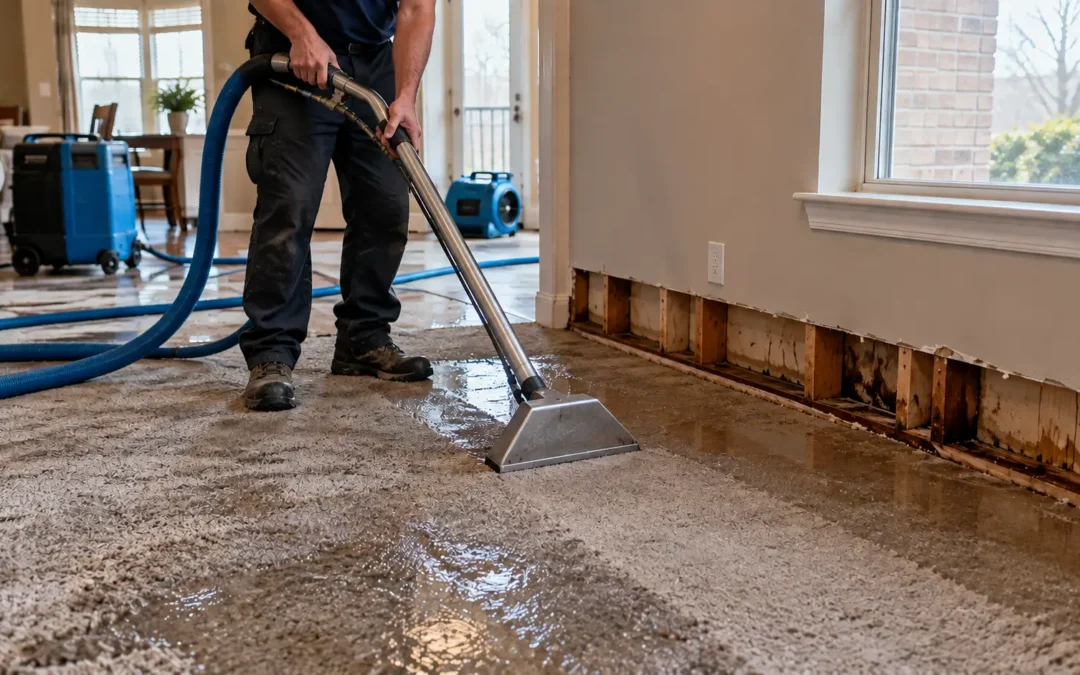


A burst washing-machine hose is a mess when you’re home to hear it. When you’re 1,500 miles away for ten days, it’s a catastrophe. The water doesn’t stop — it runs hour after hour into an empty house, soaking floors, walls, and ceilings while nobody’s there to shut the valve. The worst water-damage jobs we see in DFW almost always start with the same sentence: “We came home from vacation to…”
Here’s how to leave town without leaving your home defenseless — a short pre-trip routine that takes minutes and prevents the worst.
Key Takeaways
- A leak in an empty home runs undetected for days, which is why unoccupied-home water losses tend to be far more severe than ones caught quickly.
- The single most effective step before a trip: shut off the main water supply, or at least the washing machine and icemaker valves.
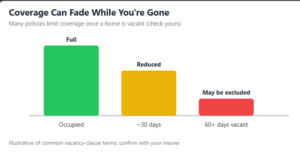
- Check your policy — many home insurance policies reduce or exclude coverage once a home sits vacant for 30 to 60 days.
- Pair a shutoff with monitoring: a smart leak detector or a trusted person checking in catches trouble early.
Why Is Water Damage Worse in an Empty House?
Because time is the multiplier. The size of the leak matters far less than how long it runs, and in an empty home nothing stops it. A slow drip you’d wipe up in seconds becomes days of saturation; a burst supply line floods room after room. That’s why losses in unoccupied homes are so severe — a point the Insurance Institute for Business & Home Safety (IBHS) has long emphasized in its interior-water research (IBHS).
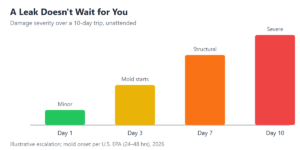
Time also changes the water itself. Clean water that sits degrades into contaminated water and feeds mold, which the EPA says can begin within 24 to 48 hours of materials getting wet (EPA). So a leak on day two of a ten-day trip isn’t a day-two problem when you return — it’s eight days of damage, mold, and rot. Water damage is already the second most common home insurance claim, averaging $15,400 (Insurance Information Institute, 2025) — and an unattended leak lands at the punishing end of that range. One inch of water alone can cause up to $25,000 in damage (This Old House).
For the full picture on how quickly clean water turns dangerous, see our guide to the 3 water damage categories.
Should You Shut Off the Water Before You Leave?
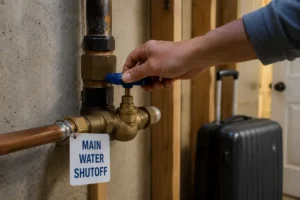
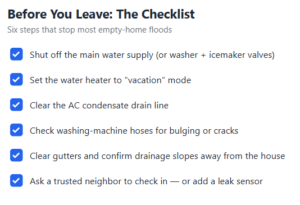
Yes — this is the highest-value thing you can do. If no water is flowing into the house, a failed hose or valve has nothing to release. For any trip longer than a weekend, shut off the main water supply valve; for shorter trips, at least close the valves behind the washing machine and to the refrigerator’s icemaker.
Find your main shutoff before you need it. It’s usually where the water line enters the house — near the water heater, in a garage, or at an exterior box near the street. Turn it clockwise to close, then open a faucet to confirm the flow stops. It takes thirty seconds and it’s the closest thing to insurance against the most common failures — like the appliance water leaks that top the list of household floods.
What About the Water Heater and Appliances?
Handle the appliances that fail most often. If you shut off the main, your tank water heater is fine, but for long absences you can set it to “vacation” mode to save energy. The bigger risk is the appliances tied to a water line: the water heater itself, the washing machine hose, the refrigerator icemaker line, and — in North Texas summers — the air conditioner.
Don’t forget the AC. If you leave it running in a Texas summer (which you may, to control humidity), a clogged condensate line can overflow and flood a ceiling while you’re gone — exactly the scenario in our guide to AC condensate leaks. Clear the drain line before you go. And if your water heater is aging or already showing rust or moisture, deal with it before the trip — our guide to a water heater leaking explains the warning signs.
Your Pre-Trip Water-Damage Checklist
Run this list before every extended trip. None of it takes long, and together it closes off nearly every way an empty house floods. The goal is simple: stop the water, reduce the risks you can’t stop, and make sure someone (or something) is watching.
Will Insurance Cover Water Damage in a Vacant Home?
Maybe not — and this surprises people. Sudden, accidental water damage is generally covered, but most home insurance policies contain a vacancy or unoccupancy clause that reduces or suspends coverage once a home sits empty beyond a set period, commonly 30 to 60 days. If a pipe bursts on day 45 of an empty house, you could find the claim denied.
For a normal one- or two-week vacation, you’re typically fine. The risk grows for extended absences — long snowbird trips, a second home, a rental between tenants, or an estate. If you’ll be away that long, call your agent before you go and ask exactly how your policy treats an unoccupied home. Read the clause; don’t assume.
How Can You Monitor Your Home Remotely?
Technology and a trusted person are your eyes while you’re gone. A smart leak detector placed near the water heater, washing machine, and under sinks costs little and pings your phone the instant it senses moisture — enough warning to call someone before a drip becomes a flood. For the strongest protection, an automatic shutoff valve monitors the water main and cuts the supply the moment it detects a burst.
Low-tech works too. Ask a neighbor, friend, or house-sitter to walk through every few days and actually look and listen — a running sound, a warm spot, a musty smell. Give them your main shutoff location and a phone number to call. Between a sensor and a set of eyes, most empty-home disasters get caught while they’re still small.
You Came Home to a Flood — Now What?
Act fast, because days-old water is a different problem than a fresh spill. Shut off the water at the main, stop using electrical outlets in wet areas, and open windows to start airing it out. Then document everything with photos before you move anything — you’ll need it for the claim.
Then call a professional, quickly. Water that’s been sitting for days has almost certainly degraded and started growing mold, so this isn’t a shop-vac-and-fans situation. At SS Water Restoration, our IICRC-certified team finds hidden moisture with meters and thermal imaging, dries the structure, and documents the loss for your insurer. Founder Stephan Sannikov (license #RCO1659) leads a crew offering 24/7 water damage restoration across Collin and Denton County.
Walked into a flooded house? Call SS Water Restoration 24/7 at (469) 737-0296 for a free North Texas inspection. We respond fast, dry it right, and bill your insurance directly.
Frequently Asked Questions
Should I turn off my water when I go on vacation?
Yes — it’s the single best step. For trips longer than a weekend, shut off the main supply so a failed hose or valve has nothing to release. For short trips, at least close the washing machine and icemaker valves, since appliance supply lines are a top cause of home floods.
Does homeowners insurance cover water damage in a vacant home?
Often not, after a point. Many policies include a vacancy clause that reduces or excludes coverage once a home is empty for 30 to 60 days. A normal vacation is usually fine, but for extended absences, confirm with your insurer before you leave — don’t assume you’re covered.
Should I turn off the water heater on vacation?
If you’ve shut off the main water supply, the water heater is fine as-is. For longer trips you can switch it to “vacation” mode to save energy. If the heater is old or showing rust or moisture, address it before you travel — a tank failure floods fast.
How can I prevent my house from flooding while I’m away?
Shut off the water, clear the AC condensate line, check appliance hoses, and set up monitoring — a smart leak detector or a neighbor checking in. Because mold can start within 24–48 hours (EPA), early detection is what limits the damage.
How long can a house sit empty before it’s a problem?
Risk rises with time. The mold clock starts within 24–48 hours of any leak, and insurance vacancy clauses commonly kick in around 30 to 60 days. For anything beyond a couple of weeks, shut off the water and arrange for someone to check the home regularly.
The Bottom Line for North Texas Homeowners
An empty house can’t call for help — so set it up to defend itself before you go. Here’s what to remember:
- In an empty home, time multiplies the damage; a small leak becomes a five-figure loss.
- Shut off the water (main, or at least washer and icemaker) — the highest-value step.
- Clear the AC condensate line and check appliance hoses before a Texas summer trip.
- Check your policy’s vacancy clause, and set up a leak sensor or a neighbor to watch.
Leaving town soon? Do the checklist. And if you come home to water, call SS Water Restoration 24/7 at (469) 737-0296 for a free inspection.
Sources
- Insurance Institute for Business & Home Safety (IBHS), State of the Risk: Interior Water Damage, retrieved 2026-07-02, https://ibhs.org/interior-water/state-of-the-risk-interior-water-damage/
- U.S. Environmental Protection Agency, A Brief Guide to Mold, Moisture and Your Home, retrieved 2026-07-02, https://www.epa.gov/mold/brief-guide-mold-moisture-and-your-home
- Insurance Information Institute, Facts + Statistics: Homeowners and renters insurance, retrieved 2026-07-02, https://www.iii.org/fact-statistic/facts-statistics-homeowners-and-renters-insurance
- This Old House, Water Damage Statistics (citing FEMA), retrieved 2026-07-02, https://www.thisoldhouse.com/foundations/water-damage-statistics