

Not all water damage is equal. The clean water from a burst supply line and the sewage backing up through a floor drain are treated as two completely different emergencies — even if they leave the same size puddle. What separates them isn’t the amount of water. It’s the category.
This guide breaks down the three water damage categories, the health risk each one carries, and why a “small clean leak” can turn into a biohazard faster than most Texas homeowners expect.
Key Takeaways
- Water damage is graded in three categories — Category 1 (clean), 2 (gray), and 3 (black) — under the IICRC S500 standard that restoration pros work to.
- The category, not the volume, decides your health risk, your cleanup method, and often your insurance outcome.
- Clean water doesn’t stay clean: untreated Category 1 can degrade to Category 2 or 3 within 24–48 hours.
- Category 3 (black) water is a biohazard — the CDC links contaminated floodwater to diarrheal disease, wound infections, and other illness.
What Are the 3 Categories of Water Damage?
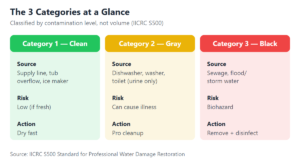
Water damage is classified into three categories by contamination level, defined under the IICRC S500 Standard for Professional Water Damage Restoration (IICRC). Category 1 is clean water from a sanitary source, Category 2 is “gray” water with meaningful contamination, and Category 3 is “black” water that’s grossly contaminated. The category measures how dirty the water is — not how much of it there is.
Why does that distinction matter so much? Because the category drives every decision that follows: whether materials can be dried or must be torn out, what protective gear the crew wears, and how your insurer treats the claim. A pro’s first job on any loss is to identify the category before touching anything.
What Is Category 1 (Clean Water) Damage?
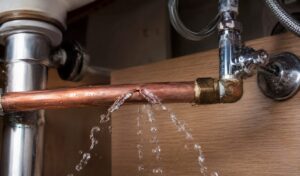
Category 1 is water that escapes from a clean, sanitary source and carries little immediate health risk. Think of a broken copper supply line, an overflowing bathtub of clean water, a failed water-heater connection, or a leaking ice-maker line. It’s the “best case” of a bad situation — the water itself won’t make you sick on contact.
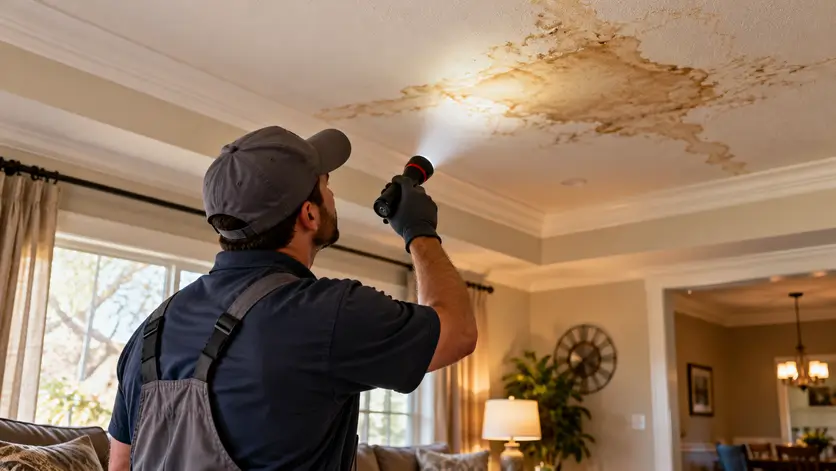
But clean doesn’t mean harmless. Left in the structure, Category 1 water soaks into drywall, carpet pad, and baseboards, and the clock starts immediately. One of the most common Category 1 sources we see in DFW summers is a quietly overflowing air handler — the kind of AC condensate leak that drips through a ceiling for days before anyone notices.
What Is Category 2 (Gray Water) Damage?
Category 2 — “gray water” — carries significant contamination and can cause discomfort or illness if you touch or swallow it. It comes from sources that aren’t sewage but aren’t clean either: a dishwasher or washing-machine discharge, a sink drain backup, or a toilet overflow that contains urine but no feces.
Gray water is the middle ground people most often underestimate. It looks like ordinary water, so homeowners mop it up with bare hands and a towel. The problem is what’s dissolved in it — soaps, detergents, food waste, and bacteria that multiply fast in a warm Texas house. Category 2 losses generally need professional extraction and disinfection, not a beach towel.
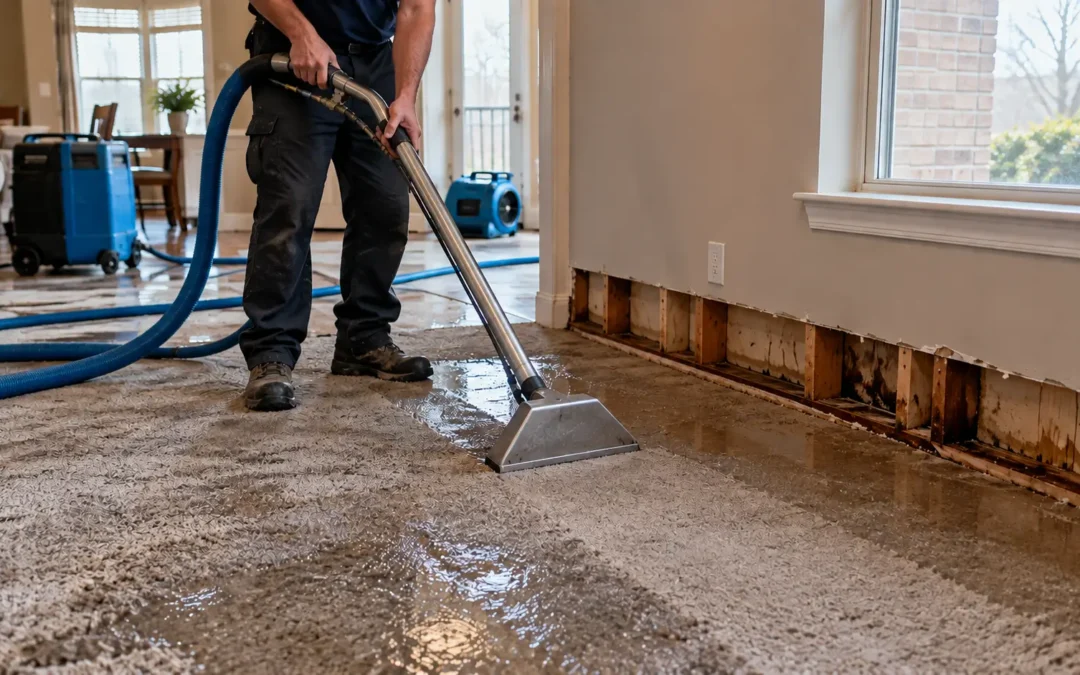
A common example: a second-floor washing machine supply hose bursts while the family is out. By the time anyone’s home, gray water has soaked the carpet pad, wicked up the drywall, and settled into the subfloor. The water that started as a laundry overflow is now feeding bacteria in three materials at once. This is why Category 2 losses are rarely “just dry it” jobs — the contaminated materials that hold moisture longest, like carpet pad and insulation, often can’t be salvaged and have to come out.
What Is Category 3 (Black Water) Damage?
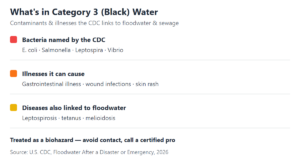
Category 3 — “black water” — is grossly contaminated and is treated as a biohazard. It includes sewage backups, rising river or creek water, and storm/flood water that has run across the ground. This is the category where the health risk stops being theoretical.
The CDC warns that floodwater can contain sewage and disease-causing germs, and that contact or ingestion can cause gastrointestinal illness (such as E. coli or Salmonella infection), wound infections, skin rashes, and diseases like leptospirosis and tetanus (CDC). Black water isn’t a cleaning job — it’s a containment job. It calls for professional sewage cleanup with proper PPE, and porous materials that soaked it up usually have to be removed, not dried.
How Fast Does Clean Water Become Contaminated?
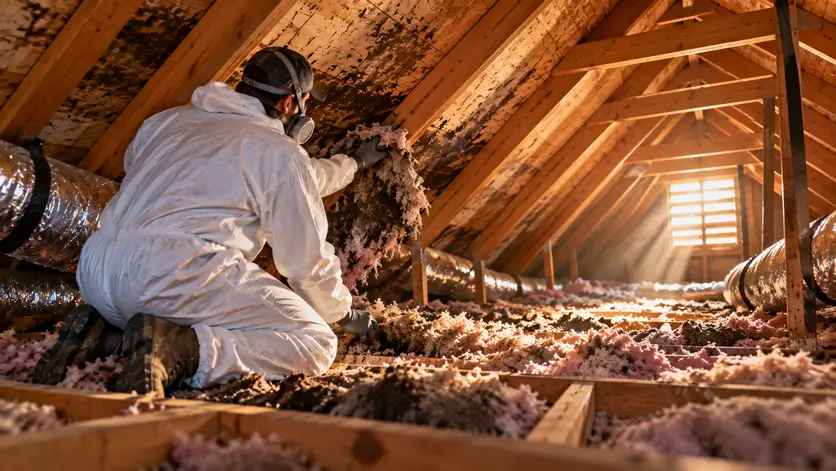
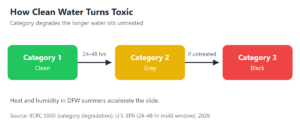
Categories are time-sensitive, and this is the point most homeowners miss. Clean Category 1 water degrades into Category 2 or 3 as it sits — absorbing contaminants from drywall, carpet backing, dust, and organic matter — often within 24 to 48 hours. That window lines up with mold, too: the EPA advises drying wet materials within 24–48 hours to prevent mold growth (EPA).
In North Texas, summer heat and humidity push that clock even faster. A supply-line leak that was harmless Category 1 water on Friday evening can be a bacteria-laden Category 2 problem by Sunday. The category you had is rarely the category you’re left with — which is why response time, not just water volume, decides how bad a loss gets. Catching it early is why the early signs of water damage are worth knowing.
Why the Category Matters for Insurance and Cleanup
The category shapes both your repair bill and your insurance claim. It decides whether soaked drywall and carpet can be dried in place or must be removed and replaced — and that difference drives most of the cost. Water damage is already an expensive, common claim: in 2025, the Insurance Information Institute reported that water damage and freezing made up 22.6% of all home insurance claims, averaging $15,400 per claim (Insurance Information Institute, 2025).
Documentation is where the category quietly matters most. Adjusters want to know the source and the contamination level, because those determine what’s covered and what’s reasonable to replace. A clear record — photos, the source, and a professional category assessment — protects your claim. If mold has already taken hold from a degraded loss, you may also need mold remediation, which is a separate line item.
When Should You Call a Professional?
Call a certified pro for any Category 2 or 3 water — and for any Category 1 that’s been sitting longer than about 24 hours. By then, the category has likely moved, and what looks like a simple dry-out may already involve contamination or mold. Gray and black water, in particular, are not DIY jobs; the risk of spreading pathogens through your home is real.
At SS Water Restoration, our IICRC-certified team identifies the water category first, contains it, removes what can’t be safely saved, and dries the structure — then documents everything for your insurer. Founder Stephan Sannikov (license #RCO1659) leads a crew that handles water damage restoration across Collin and Denton County.
Not sure what you’re dealing with? Call SS Water Restoration 24/7 at (469) 737-0296 for a free North Texas inspection. We’ll identify the category, handle it safely, and bill your insurance directly.
Frequently Asked Questions
What’s the difference between gray water and black water?
Gray water (Category 2) carries significant contamination — from appliances or a urine-only toilet overflow — and can cause illness on contact. Black water (Category 3) is grossly contaminated with sewage or floodwater and is a biohazard, containing pathogens the CDC links to serious illness (CDC).
Is Category 3 water dangerous to touch?
Yes. Category 3 black water can carry sewage bacteria and other harmful germs. The CDC notes that contact with contaminated floodwater can cause gastrointestinal illness, wound infections, and diseases such as leptospirosis and tetanus (CDC). Avoid contact and call a professional with proper protective equipment.
How long before clean water becomes black water?
Faster than most people think. Untreated Category 1 water can degrade to Category 2 or 3 within 24–48 hours as it absorbs contaminants — the same window in which the EPA says mold can begin to grow (EPA). Heat and humidity speed it up.
Does homeowners insurance cover black water damage?
Often, sudden and accidental water damage is covered, while damage from long-term neglect may not be. Water damage and freezing account for 22.6% of all home claims, averaging $15,400 (Insurance Information Institute, 2025). Document the source and category promptly and file right away.
Can I clean up Category 1 water myself?
Small, fresh Category 1 spills can sometimes be handled yourself — shut off the source, remove standing water, and dry the area within 24 hours. But if it has spread into walls or sat overnight, treat it as a professional job. Remember, one inch of water can cause up to $25,000 in damage (This Old House).
The Bottom Line for North Texas Homeowners
The category is the single most important fact about any water loss. Here’s what to remember:
- Three categories — Category 1 (clean), 2 (gray), 3 (black) — ranked by contamination, not volume.
- The category, not the puddle size, sets the health risk, the cleanup method, and the insurance stakes.
- Clean water degrades to contaminated within 24–48 hours, and DFW heat accelerates it.
- Any gray or black water — or clean water that’s sat overnight — is a job for a certified pro.
Don’t guess at the category. If you’ve got standing water anywhere in DFW, call SS Water Restoration 24/7 at (469) 737-0296 for a free inspection.
Sources
- IICRC, S500 Standard for Professional Water Damage Restoration (governing standard for the water categories), retrieved 2026-07-02, https://iicrc.org/s500/
- U.S. Centers for Disease Control and Prevention, Floodwater After a Disaster or Emergency — Safety, retrieved 2026-07-02, https://www.cdc.gov/floods/safety/floodwater-after-a-disaster-or-emergency-safety.html
- U.S. Environmental Protection Agency, A Brief Guide to Mold, Moisture and Your Home, retrieved 2026-07-02, https://www.epa.gov/mold/brief-guide-mold-moisture-and-your-home
- Insurance Information Institute, Facts + Statistics: Homeowners insurance, retrieved 2026-07-02, https://www.iii.org/fact-statistic/facts-statistics-homeowners-and-renters-insurance
- This Old House, Water Damage Statistics (citing FEMA), retrieved 2026-07-02, https://www.thisoldhouse.com/foundations/water-damage-statistics