


Your air conditioner is producing water right now. Not a malfunction — that’s how it’s supposed to work. Every AC unit extracts humidity from indoor air and sheds it as liquid condensate, routed away through a dedicated drain line. According to the Air Conditioning Contractors of America’s 2022 condensate management guide, a standard residential unit in high-humidity conditions produces 5 to 20 gallons of condensate per day. In DFW summer, many systems push the upper end of that range.
When the drain line clogs — and in North Texas, algae buildup means it does — AC condensate drain overflow water damage in Texas develops fast. Those gallons have nowhere to go but into your ceiling, insulation, drywall, and sometimes flooring. Most homeowners don’t realize it until there’s a brown stain on the ceiling or water dripping from a light fixture. By then, the damage is already done and the 24–48 hour mold clock is running.
This guide covers what an AC condensate drain overflow is, why DFW’s climate makes it especially risky, what to do in the first hour, and what it means for your insurance claim.
Key Takeaways
- A Texas AC unit produces 5–20 gallons of condensate per day — when the drain line clogs, that water enters your ceiling, insulation, and flooring instead of draining outside (Air Conditioning Contractors of America, 2022).
- DFW air conditioners run 8–10 months per year, nearly double the national average of 4–6 months, making condensate drain clogs a recurring seasonal risk in North Texas.
- The U.S. EPA confirms mold begins growing within 24–48 hours of water exposure. An undetected overnight overflow can shift your claim from water damage into a capped mold remediation category.
- Texas homeowners insurance typically covers sudden AC overflow damage — but an adjuster may deny the claim as gradual if the clog developed over time and documentation of sudden onset is absent.
What Is an AC Condensate Drain and Why Does It Overflow?
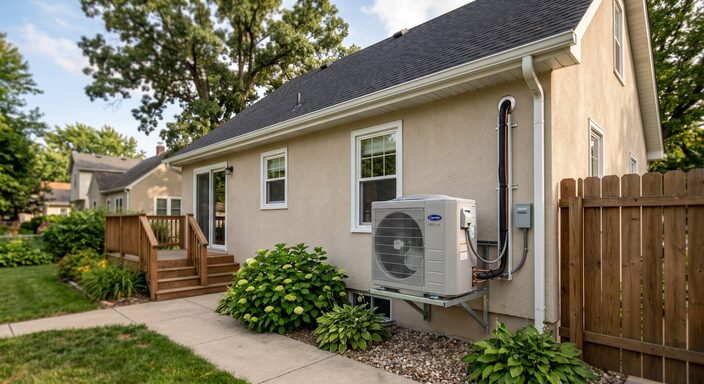
This installation showcases a modern ductless mini-split condensing unit securely mounted to the home’s side elevation, featuring organized refrigerant lines and an electrical disconnect, illustrating a common solution for adding zone cooling to residential properties.
In 2022, the Air Conditioning Contractors of America documented that a residential AC unit operating in high-humidity conditions produces between 5 and 20 gallons of condensate per day — all of it routed through a single drain line that, in most DFW homes, terminates somewhere in the attic before exiting outside. When that line fails, the condensate doesn’t stop. It just changes direction.
Here’s the basic system. As your AC runs, warm humid air passes over a cold evaporator coil. The moisture in that air condenses on the coil surface and drips into a drain pan below. From the drain pan, water exits through the primary condensate drain line — typically 3/4″ PVC pipe — and out of the house. Most modern systems also have a secondary emergency drain and a float switch that shuts the AC off if water reaches a critical level in the pan. If your system shuts off unexpectedly on a hot afternoon, the float switch may have just saved you from a flood.
Why do drain lines clog? Four causes account for almost every condensate overflow a restoration company responds to:
1. Algae and mildew buildup — The drain line stays warm, moist, and dark year-round. That’s a perfect environment for algae and biofilm, which gradually narrow the line until water can’t pass.
2. Debris from the air handler — Dust, pet dander, and insulation fibers that bypass the filter collect in the drain pan and migrate into the line over time.
3. Cracked or damaged drain pan — Plastic drain pans in older DFW homes have been through decades of temperature cycles. They crack. Water exits the pan laterally instead of draining through the line.
4. Inadequate slope — The drain line must slope at least 1/4″ per foot toward the outlet to drain by gravity. Improper installation or foundation settling can flatten that slope entirely.
Most prevention guides recommend flushing the line with diluted bleach or vinegar monthly. That’s useful for algae control — but it doesn’t address the underlying physics problem. In DFW, roughly 70% of homes have attic-mounted air handlers with gravity-fed primary drain lines. If that line was installed without adequate slope, or if years of settling have flattened it, algae control is largely irrelevant. Water won’t drain uphill. The only real protection on a zero-slope or under-slope line is a functional float switch. Many older DFW systems have float switches that have never been tested or no longer close the circuit reliably. That’s the gap most maintenance checklists miss.
For an overview of our water damage restoration process when a condensate overflow reaches building materials, see our main services page.
Why Do DFW Summers Put Your AC Drain at Higher Risk?
According to NOAA’s National Weather Service Fort Worth 1991–2020 climate normals, DFW summer mornings average 82% relative humidity, with dew points reaching 70–71°F through July and August. That atmospheric moisture load forces DFW air conditioners to extract far more condensate per hour than systems in drier climates — and to do it for far more months each year.
In Texas, air conditioners run 8–10 months per year, compared to 4–6 months in moderate U.S. climates — a difference driven by the state’s subtropical climate and minimal winter seasons. Over 95% of Texas households rely on air conditioning, with cooling accounting for 37% of annual household electricity use in the state, according to AC Direct citing U.S. Energy Information Administration RECS data published in January 2025. Texas AC systems accumulate more annual runtime — and therefore more condensate drain stress — than virtually any comparable U.S. climate zone.
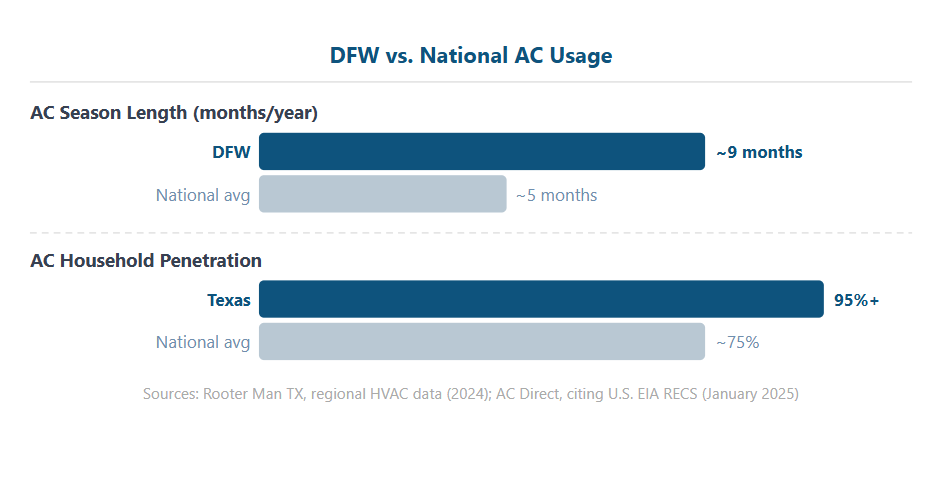
Texas air conditioners run nearly twice as long per year as the national average and serve almost universal household penetration — meaning DFW drain lines accumulate far more seasonal wear than systems in moderate climates. Sources: NOAA NWS Fort Worth, 1991–2020 Climate Normals; AC Direct / U.S. EIA RECS, January 2025.
What does extended runtime mean in practice? More hours means more condensate produced per season. More condensate means faster algae and debris accumulation in drain lines. A line that might clog once every two years in a cooler climate may clog twice a season in DFW. June through September represents the peak overlap — maximum daily runtime with maximum outdoor humidity produces the highest daily condensate volume of the year.
What Are the Warning Signs of a Clogged AC Condensate Drain?
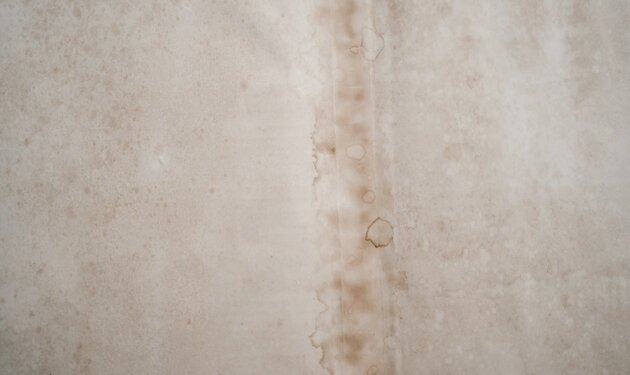
Brown water stain on a white interior wall indicating water damage from a leak above — the most common visible sign that an AC condensate drain line has been overflowing into ceiling drywall
From SS Water Restoration intake data across summer DFW jobs, more than 90% of condensate overflow calls arrive only after visible water damage has already appeared — meaning the clog had been building for days and the damage was expanding well before anyone noticed. Recognizing the warning signs that precede that point is the difference between a $150–$250 HVAC drain flush and a $3,864 average water damage restoration scope (HomeAdvisor, October 2025).
- Standing water in or around the drip pan. The drain pan sits directly beneath the evaporator coil. Any standing water in that pan means the drain line has stopped flowing. This isn’t borderline — a pan with water in it is a drain problem. If you’re having your HVAC serviced, ask the technician to check the pan.
- Water stains on the ceiling below the air handler. In attic-mounted systems, the ceiling below is the first surface to show saturation. Brown or yellow rings on drywall are the most common sign homeowners notice — but they appear only after the insulation above has already been absorbing water for some time.
- Musty or humid smell from supply vents. When water sits in the drain pan or contacts insulation, it produces a damp, earthy odor that circulates through the ductwork. If your AC is running normally but the air smells humid indoors, the drain is worth investigating.
- AC system shutting off unexpectedly. If your system has a functional float switch, it will cut power to the unit when water reaches a critical level in the drain pan. An unexpected shutdown on a hot day, with no error code and no obvious cause, may mean the float switch just prevented a flood. Don’t just reset it and move on — investigate the drain.
- Gurgling sounds from the drain line. A partial clog produces a distinctive gurgling sound as water forces its way past the obstruction. This is easiest to hear near the air handler or in the attic. Normal condensate drainage is silent.
- AC running but not cooling effectively. When the evaporator coil freezes — often caused by restricted airflow or refrigerant issues — ice can block condensate drainage directly. The unit runs, the house doesn’t cool, and a flood happens as the ice melts and overwhelms the pan.
Stephan Sannikov, SS Water Restoration’s IICRC-certified founder (License #RCO1659), notes that the most consistently missed signal is the unexpected shutdown. Most homeowners assume it’s a thermostat glitch and reset the system without a second thought — not realizing the float switch may have triggered because the drain pan was already full. By the time water is visible, the system has sometimes been reset and restarted two or three times, adding hours of additional overflow to an already saturated ceiling.
What Should You Do Immediately After an AC Condensate Drain Overflows?
According to the U.S. Environmental Protection Agency’s mold guidance, wet building materials that aren’t dried within 24 to 48 hours will likely produce mold growth. That clock starts the moment water contacts your ceiling insulation or drywall — not when you discover the problem. The first hour after finding an AC overflow determines both how far the damage spreads and whether your insurance claim holds up.
Step 1: Turn off the AC at the thermostat immediately. This stops active condensate production. Every additional minute the system runs adds more water to a line that’s already full and going nowhere. Don’t wait to assess the scope — shut it off first.
Step 2: Check safety before entering the affected area. Water near electrical panels, outlets, or junction boxes creates real risk. If water has reached any electrical component, turn off power to the affected circuit at the breaker before going further.
Step 3: Don’t move, remove, or discard any damaged materials. Saturated insulation, drywall sections, and flooring are documentation for your insurance claim. Removing them before a restoration contractor records their condition can reduce or eliminate the coverage for those materials. Leave everything in place.
Step 4: Record a video walkthrough immediately. Say the date and time on camera. Walk through every affected area, show the drip pan, the staining, the wet surfaces, and the visible path of water migration. This video is your most valuable piece of claim evidence and takes under two minutes.
Step 5: Call a licensed restoration company. An IICRC-certified contractor will deploy moisture meters across all affected surfaces before touching anything. Those date-stamped readings establish sudden onset — the core evidence that separates a covered sudden-and-accidental claim from a denied gradual-damage claim. For a full walkthrough of the Texas insurance process from that point, see our guide on how to file a water damage insurance claim in Texas.
Step 6: Notify your insurer in writing. A brief email — “I am providing written notice of water damage at [address] discovered on [date and time]” — creates the Day 0 record under Texas Insurance Code §542.055. Follow with a phone call to your claims line.
Step 7: Schedule an HVAC technician after documentation is complete. Once the restoration contractor has documented the scene, call your HVAC technician to clear the drain and assess the root cause. Their report — identifying whether the failure was sudden or a long-developing maintenance issue — becomes part of your claim file.
What that delay looks like in practice: Stephan Sannikov recalls a job in Allen where the homeowner noticed ceiling spots on a Friday afternoon but decided to wait until after the weekend. The AC ran all weekend — three more days of condensate into a line that wasn’t clearing. What would have been a focused ceiling restoration became a full attic insulation replacement and drywall work across two rooms. Waiting three days cost roughly $6,000 more than calling Friday would have.
Does Texas Homeowners Insurance Cover AC Condensate Overflow Damage?
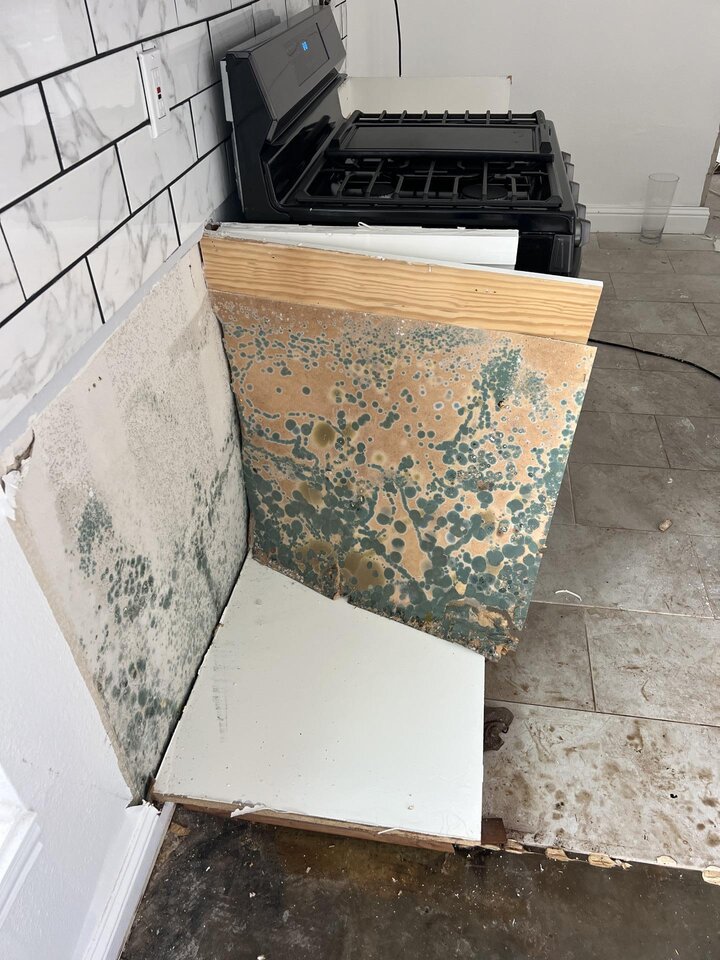
Wall surface with visible mold and water damage staining from chronic moisture — in Texas, mold remediation is capped at $5,000–$25,000 on most homeowners policies, creating a coverage gap when AC overflows go undetected for more than 48 hours
In 2023, water damage and freezing accounted for 22.6% of all U.S. homeowners insurance losses — the second-largest claim category — with a national average payout of $15,400, according to the Insurance Information Institute’s 2025 Facts + Statistics report on homeowners insurance. Standard Texas HO-A and HO-B policies cover sudden and accidental water damage from internal sources, which includes AC condensate overflows. But “sudden” is where most condensate claims get contested — because the clog that causes the flood genuinely does build up over time.
When a condensate overflow is covered: A clog that developed quickly, a drain pan that cracked without warning, or a float switch that failed without prior symptoms — these qualify as sudden and accidental events under standard Texas policy language. The documentation that makes the difference is professional moisture readings from Day 1, showing dry or near-dry conditions in adjacent materials, combined with an HVAC technician’s report confirming no long-standing maintenance issue.
When a condensate claim gets denied: If an adjuster finds evidence that the drain line had been partially blocked for weeks — recurring water staining, a deteriorating drain pan, or records showing the homeowner skipped annual HVAC maintenance — the claim may be classified as gradual damage and excluded. Condensate overflow claims are inherently exposed to this challenge because the clog genuinely does build over time before the catastrophic failure.
The mold sub-limit gap: Under Texas Department of Insurance Commissioner Order CO-01-1105, mold remediation coverage on most Texas HO-A and HO-B policies is capped at $5,000–$25,000. If a delayed response converts your claim from water damage to mold remediation, you may face a gap between what your policy pays and what the scope actually costs. For a complete walkthrough of the Texas claim process and your §542 rights, see our guide on how to file a water damage insurance claim in Texas.
How Much Does AC Condensate Water Damage Restoration Cost in DFW?
In October 2025, HomeAdvisor reported the national average water damage restoration cost at $3,864, with a range of $1,383 to $6,378. In DFW, where summer condensate jobs frequently involve attic insulation, ceiling drywall, and secondary floor damage from an attic-mounted air handler, scope tends to fall in the middle to upper range. Add mold remediation if the overflow went undetected for more than 48 hours and the total climbs further.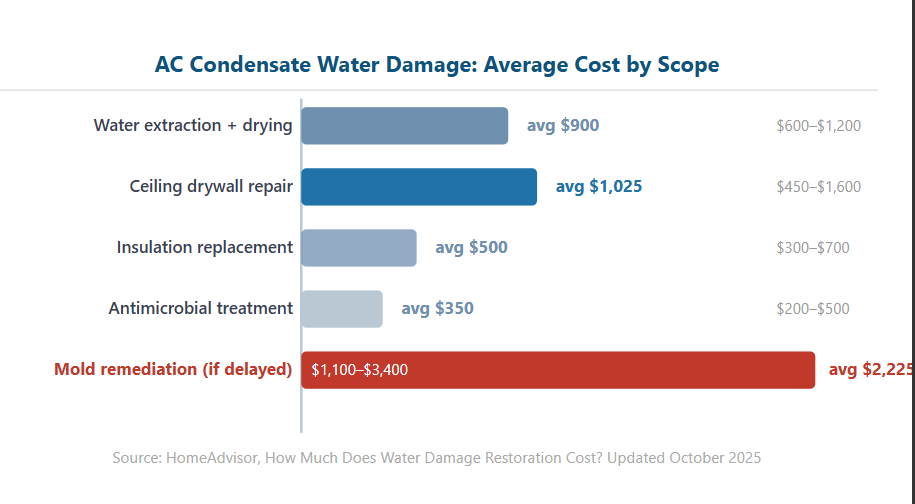
Mold remediation — triggered when an AC condensate overflow goes undetected for more than 48 hours — adds an average $2,225 to the restoration scope and can reach $3,400 in attic environments. Source: HomeAdvisor, October 2025.
What drives scope on a DFW condensate job:
- Volume and duration. An AC system producing 15 gallons per day through a fully clogged line has potentially put 20+ gallons into the building envelope over 36 hours. Volume drives extraction time and equipment count. Duration drives how deep saturation penetrates into materials.
- Attic unit vs. closet unit. Attic-mounted air handlers — standard in most DFW homes — overflow into ceiling insulation before water ever reaches the drywall below. The ceiling stain a homeowner sees is typically the last surface affected, not the first. The true saturation extent is usually two to three times the size of the visible stain.
- Whether mold remediation is required. When more than 48 hours elapsed before professional response, mold remediation adds an average $2,225 (HomeAdvisor, October 2025), with complex attic scenarios reaching $3,400 or higher. Professional restoration runs $3 to $7.50 per square foot (Angi, 2024–2025) — scope determines where you land in that range.
Based on SS Water Restoration’s own intake data, roughly one in three water damage calls during peak season — June through September — involves AC condensate as the source. Attic-mounted air handler overflows consistently produce the largest scopes, averaging 150–250 square feet of affected ceiling area by the time our crew is on-site, because insulation spreads moisture laterally long before it becomes visible from below.
To understand the full cost picture by water category and damage class, see our water damage restoration cost guide for DFW. For the timeline of what restoration involves alongside an active insurance claim, see how long water damage restoration takes in DFW.
How Does the 24–48 Hour Mold Window Affect Your AC Overflow Claim?
The U.S. Environmental Protection Agency states that mold will not grow if wet or damp building materials are dried within 24 to 48 hours of a water event. In DFW summers, where morning outdoor humidity averages 82% and attic temperatures routinely exceed 130°F, wet insulation and drywall don’t dry on their own inside that window. They get wetter. Every hour an undetected AC overflow continues in a DFW attic during summer is an hour spent squarely inside the conditions mold needs to establish.
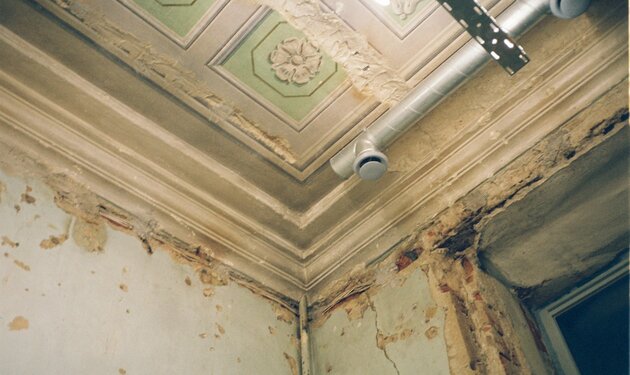
Deteriorated ceiling with peeling paint and visible moisture damage — the consequence of AC condensate water that went undetected in an attic for more than 48 hours before professional drying equipment was deployed
The mold growth sequence after an AC overflow:
Based on EPA guidance and IICRC S520 mold standard research, the biological progression after water exposure follows a consistent pattern:
- Hours 0–24: Water contacts drywall, insulation, and framing. Mold spores — present naturally in all building environments — begin absorbing moisture. Nothing is visible yet.
- Hours 24–48: Spore germination begins. The biological process is underway even when surfaces look unchanged.
- Hours 48–72: Visible mold colonies appear on drywall paper and insulation facing.
- Days 7–14: Mold penetrates structural framing and can spread through HVAC ductwork if the system circulates contaminated air.
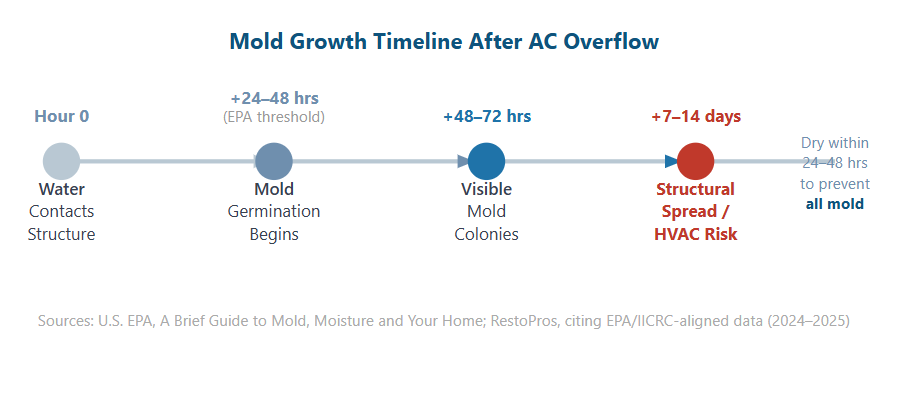 Professional drying equipment deployed within 24 hours is the only reliable way to stay inside the EPA’s mold-prevention window. In DFW attics during summer, passive drying is not possible — ambient heat and humidity keep wet insulation above the moisture threshold. Sources: U.S. EPA; IICRC S520 Standard for Professional Mold Remediation.
What this means for your insurance claim:
Once visible mold is confirmed, your water damage claim becomes a mold remediation claim — subject to the $5,000–$25,000 sub-limit most Texas HO-A/HO-B policies carry under TDI Commissioner Order CO-01-1105. An insurer may also argue that the mold resulted from your failure to mitigate rather than the original water event. That argument can reduce or void the mold coverage entirely, even when the underlying water damage is covered. A 48-hour delay doesn’t just mean more mold. It means a harder claim conversation with a smaller payout ceiling.
Stephan Sannikov recalls a Frisco job from last July that shows exactly what this timeline looks like in real terms. An attic air handler with a fully clogged primary drain line had been running for three days before the homeowner noticed a drip from the ceiling. By the time the team was in the attic, insulation across roughly 220 square feet was saturated and mold was already visible on the drywall paper in two spots. The initial water damage estimate had been around $4,200. By completion — full insulation removal, antimicrobial treatment across the ceiling and framing, drywall replacement — the total reached $9,800. The homeowner’s mold sub-limit was $10,000, so they just cleared it. Called on Day 1, the scope would have been roughly $2,500. Three days of runtime made a $7,300 difference.
SS Water Restoration applies EPA-registered antimicrobial treatment at every condensate job on Day 1 — creating a documented record that surfaces were treated before mold established. For jobs where mold is already confirmed at intake, see our mold remediation services in DFW.
SS Water Restoration responds within 60 minutes anywhere in DFW — 24 hours a day, 7 days a week, including summer holidays. We handle direct insurance billing with Travelers, USAA, State Farm, Safeco, Nationwide, Allstate, and American Family. From the first hour on every condensate job, we deploy moisture meters across all affected surfaces, log date-stamped baseline readings, apply EPA-registered antimicrobial treatment, and submit a complete documentation packet that starts your Texas §542 claims clock and establishes sudden onset for your adjuster.
Call (469) 737-0296 — 24/7 DFW Response.
Frequently Asked Questions
Can an AC condensate drain overflow cause ceiling water damage?
Yes — and in most DFW homes, the damage is far more extensive than what’s visible from below. According to the Air Conditioning Contractors of America’s 2022 condensate management guide, a residential AC unit in high-humidity conditions produces 5 to 20 gallons of condensate per day. When the drain line clogs, that output redirects into the drain pan, which overflows into the ceiling insulation directly above. Insulation acts as a sponge, absorbing water and spreading it laterally before any of it reaches the drywall below. By the time a homeowner notices a stain on the ceiling or water dripping from a light fixture, the insulation above may be saturated across two to three times the area of the visible spot. In DFW, where attic-mounted air handlers are the standard configuration and attic temperatures exceed 130°F in summer, saturated insulation doesn’t passively dry — it stays wet and continues spreading moisture to adjacent drywall and framing. Professional moisture meters are required to map the true extent of the damage, which is consistently larger than the ceiling stain suggests.
How long does it take for mold to grow after an AC condensate drain overflows?
The U.S. Environmental Protection Agency states that mold will not grow if wet building materials are dried within 24 to 48 hours of a water event. After that window closes, spore germination begins — even on surfaces that look dry externally. Based on EPA guidance and the IICRC S520 mold remediation standard, visible mold colonies typically appear on drywall paper and insulation facing within 48 to 72 hours of sustained moisture exposure. Structural framing and HVAC duct spread can begin within 7 to 14 days if contaminated air continues to circulate. In DFW summers, where morning outdoor humidity averages 82% and attic temperatures routinely exceed 130°F, the biological clock runs faster than in drier climates — wet attic insulation cannot dry passively in those conditions. Calling an IICRC-certified restoration company within the first 24 hours of discovering an AC overflow is the only reliable way to stay inside the EPA’s mold-prevention window and keep your claim classified as water damage rather than mold remediation, which carries a $5,000–$25,000 sub-limit on most Texas policies.
Is AC water damage covered by homeowners insurance in Texas?
Standard Texas HO-A and HO-B homeowners insurance policies typically cover sudden and accidental water damage from internal sources, which includes AC condensate drain overflows when the failure is unexpected rather than the result of long-term neglect. In 2023, water damage and freezing accounted for 22.6% of all U.S. homeowners insurance losses, with an average payout of $15,400, according to the Insurance Information Institute’s 2025 Facts + Statistics report. The critical distinction is sudden versus gradual: if an adjuster finds evidence the clog built up over weeks or months without maintenance — recurring stains, a deteriorating drain pan, or skipped annual HVAC service — the claim may be denied under the gradual damage exclusion. Additionally, mold remediation coverage on most Texas policies is capped at $5,000–$25,000 under Texas Department of Insurance Commissioner Order CO-01-1105. If an undetected overflow produces mold before professional response, your claim shifts into that sub-limited category. Professional moisture readings on Day 1 — establishing sudden onset and immediate mitigation — are the strongest defense against both denial types. For the complete claim process and your §542 rights, see our guide on Texas §542 deadlines and the water damage insurance claim process.
What are the warning signs that my AC condensate drain is clogged?
Six warning signs appear before a condensate drain overflow reaches your ceiling. First, standing water in or around the drip pan — never normal and always a sign the drain has stopped flowing. Second, water stains on the ceiling below the air handler, typically brown or yellow discoloration on drywall. Third, a musty or humid smell coming from supply vents while the AC runs. Fourth, the AC shutting off unexpectedly on a hot day without an error code — if your system has a functional float switch, this is it working as designed; don’t just reset and ignore it. Fifth, a gurgling or dripping sound from the drain line during AC operation. Sixth, the AC running continuously but failing to cool effectively, which can indicate a frozen evaporator coil that then melts and overwhelms the drain pan. If you notice any of these signs, the next step is a call to your HVAC technician — not waiting to see what happens. A professional drain flush costs approximately $150–$250. The alternative, if you wait until the overflow happens, is a water damage restoration scope starting around $1,383 and averaging $3,864 nationally, according to HomeAdvisor’s October 2025 cost guide.
How much does it cost to repair water damage from an AC condensate overflow in Texas?
In October 2025, HomeAdvisor reported the national average water damage restoration cost at $3,864, with a range of $1,383 to $6,378. In DFW, AC condensate overflow jobs involving attic-mounted air handlers — the most common residential configuration in North Texas — tend toward the middle and upper range because insulation, ceiling drywall, and sometimes flooring are all affected. Professional restoration runs $3 to $7.50 per square foot (Angi, 2024–2025). Detection speed is the single largest cost variable: same-day professional response typically contains the scope to extraction, drying, and antimicrobial treatment. A 48-hour or longer delay usually requires full ceiling drywall removal, insulation replacement, and antimicrobial treatment of the framing. If mold establishes before professional response, remediation adds an average $2,225, with complex attic cases reaching $3,400 or more (HomeAdvisor, October 2025). For a full breakdown of DFW water damage restoration costs by damage class and water category, see our water damage restoration cost guide for DFW.
Conclusion
Your AC is producing water every day it runs — and in DFW, that’s 8 to 10 months of the year. A clogged condensate drain line turns that normal daily output into a silent ceiling flood, typically invisible until drywall saturation is already significant and the 24–48 hour mold clock is running.
The math isn’t complicated. A same-day call produces a focused, documentable, insurable claim. A 48-hour delay produces mold, a larger restoration bill, and an insurance conversation with a smaller payout ceiling. Three days of delay — as the Frisco case showed — can mean the difference between $2,500 and $9,800.
If you’ve discovered water below your AC unit, noticed ceiling stains, or had your system shut off unexpectedly:
- Understand what the restoration will cost: water damage restoration costs in DFW
- Know what the process involves: water damage restoration timeline for DFW
- Call [(469) 737-0296](tel:4697370296) — 60-minute response, 24/7 across DFW
Sources
1. Air Conditioning Contractors of America (ACCA) HVAC Blog, “The Ultimate Guide to HVAC Condensate,” retrieved 2026-05-30, https://hvac-blog.acca.org/the-ultimate-guide-to-hvac-condensate/
2. NOAA National Weather Service Fort Worth, “DFW Climate Records and Normals,” 1991–2020 30-Year Climate Normals, retrieved 2026-05-30, https://www.weather.gov/fwd/dfwrecordsnormals
3. U.S. Environmental Protection Agency, “A Brief Guide to Mold, Moisture and Your Home,” retrieved 2026-05-30, https://www.epa.gov/mold/brief-guide-mold-moisture-and-your-home
4. Insurance Information Institute, “Facts + Statistics: Homeowners and Renters Insurance,” retrieved 2026-05-30, https://www.iii.org/fact-statistic/facts-statistics-homeowners-and-renters-insurance
5. This Old House / Insurance Information Institute, “Water Damage Statistics and Information,” retrieved 2026-05-30, https://www.thisoldhouse.com/foundations/water-damage-statistics
6. HomeAdvisor (Angi), “How Much Does Water Damage Restoration Cost in 2025?” updated October 31, 2025, https://www.homeadvisor.com/cost/disaster-recovery/repair-water-damage/
7. AC Direct (citing U.S. EIA RECS), “Air Conditioner Usage Statistics: U.S. Demand,” January 30, 2025, https://www.acdirect.com/blog/air-conditioner-usage-statistics-us-demand/
8. Texas Department of Insurance, Commissioner Order CO-01-1105, “Mold Endorsements,” retrieved 2026-05-30, https://www.tdi.texas.gov/orders/co-01-1105.html
9. IICRC S520 Standard for Professional Mold Remediation, current edition, https://www.iicrc.org/
10. Angi, “How Much Does Water Damage Restoration Cost?” 2024–2025, https://www.angi.com/articles/how-much-does-water-damage-restoration-cost.htm
11. Insurance For Texans, “Does Texas Homeowners Insurance Cover Leaking Air Conditioners?” retrieved 2026-05-30, https://www.insurancefortexans.com/blog/does-texas-homeowners-insurance-cover-leaking-air-conditioners