

It’s the first 100-degree stretch of a North Texas summer, your air conditioner is running almost around the clock, and there’s water pooling near the indoor unit or a brown ring spreading across the ceiling. Is it just condensation, or something worse? In most cases it’s a clogged condensate drain line, and the longer it drips, the more drywall, insulation, and framing it ruins. Here’s how to spot the cause, judge the risk, and act before a small leak becomes a five-figure repair.
Key Takeaways
- A clogged condensate drain line is one of the most common causes of an AC leaking water inside (Service Champions).
- Materials left wet beyond 24-48 hours are at risk of mold; drying within that window usually prevents it (EPA).
- Fixing the leak itself usually runs $75-$600, but hidden water damage and mold remediation cost far more (HomeGuide).
- Shut the system off, dry the area, and call a pro if water reached drywall, ceilings, or flooring.
Why is my air conditioner leaking water inside the house?
One of the most common causes of an AC water leak is a clogged condensate drain line, where dirt and algae back up the line until the drain pan overflows (Service Champions, 2026). Your system pulls humidity out of the air, and that moisture is supposed to drain away. When it can’t, it ends up on your floor or ceiling instead.
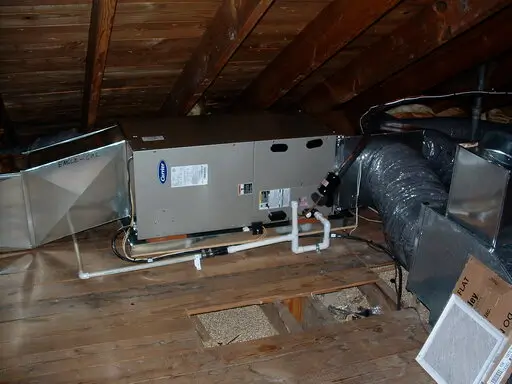
An attic-mounted HVAC air handler with visible condensate drain piping and flexible ductwork.
There are a handful of usual suspects. A clogged drain line tops the list, especially in humid Texas summers when algae grows fast. A cracked or rusted drain pan lets water through even when the line is clear. A dirty air filter or coil can freeze the evaporator; when that ice melts, it overwhelms the pan. And a failed condensate pump (common when the unit sits below the drain) simply stops moving water out.
Why does this hit DFW homes so hard? Many North Texas houses put the air handler in the attic, directly above finished ceilings. So when the pan overflows, gravity carries that water straight into your living space, often without a single drop landing where you’d notice it early.
Can a leaking AC really cause water damage?
Yes. A steady condensate leak soaks drywall, ceiling tiles, insulation, and wood framing, and if those materials aren’t dried within 24-48 hours, mold is likely to follow (EPA). What looks like a minor drip is often the visible tip of a much larger wet area hidden above the ceiling or behind a wall.
According to EPA guidance, materials that stay damp longer than 48 hours are at real risk of mold colonization, which is why drying speed, not just cleanup, decides how bad the damage gets (EPA). In an attic-unit home, insulation acts like a sponge, holding moisture against the ceiling for days.
What we see on DFW calls: During the first big heat wave each summer, attic condensate overflows are one of our most frequent water-damage callouts. By the time a homeowner notices the ceiling stain, the insulation above is usually already saturated, and the drywall has been wet for a day or more.
The warning signs worth acting on: a spreading ceiling stain, paint that bubbles or sags, a musty smell near vents, or water tracking down a wall below the air handler.
How much does it cost to fix an AC leak and the damage?
Fixing the leak itself is usually the cheap part. Repairing a leaking AC typically runs $75-$600, though complex jobs can reach $1,600 (HomeGuide, 2026). The expensive part is the water damage left behind, which depends entirely on how long the leak ran.
Component repairs land in predictable ranges. Clearing a clogged condensate line often starts around $100, a drain pan replacement runs $350-$850, and a condensate pump replacement runs $240-$450 (Ace Home, 2026).
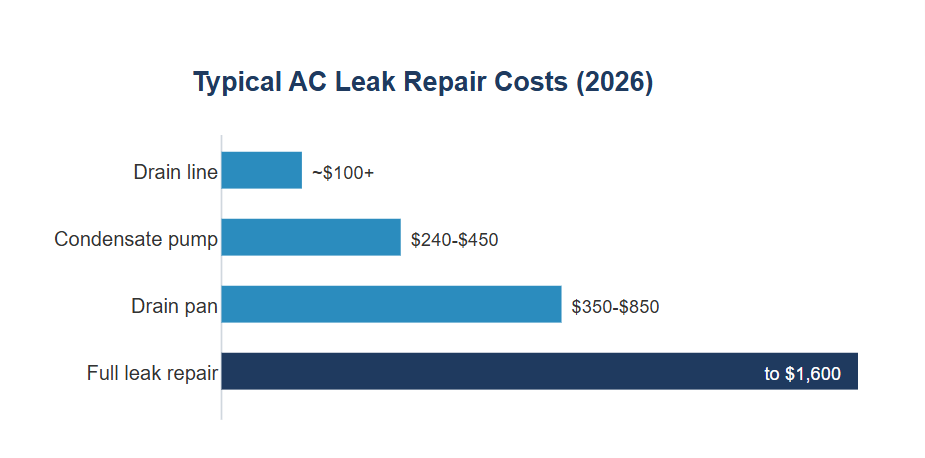
Here’s the catch: none of those figures include the drywall, ceiling, insulation, or mold work if the leak ran for days. That’s why catching it early is the real money-saver.
What should you do right now if your AC is leaking?
Shut the system off at the thermostat, soak up standing water, and start drying the area within 24-48 hours to stay ahead of mold (EPA). Turning the unit off stops new condensate from being produced while you sort out the cause.
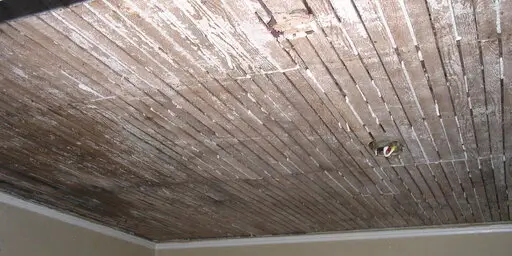
Water stains and discoloration on a wood slat ceiling caused by a leaking air conditioning system.
Work through these steps in order:
- Turn the AC off at the thermostat to stop the water source.
- Soak up standing water with towels and a wet/dry vacuum.
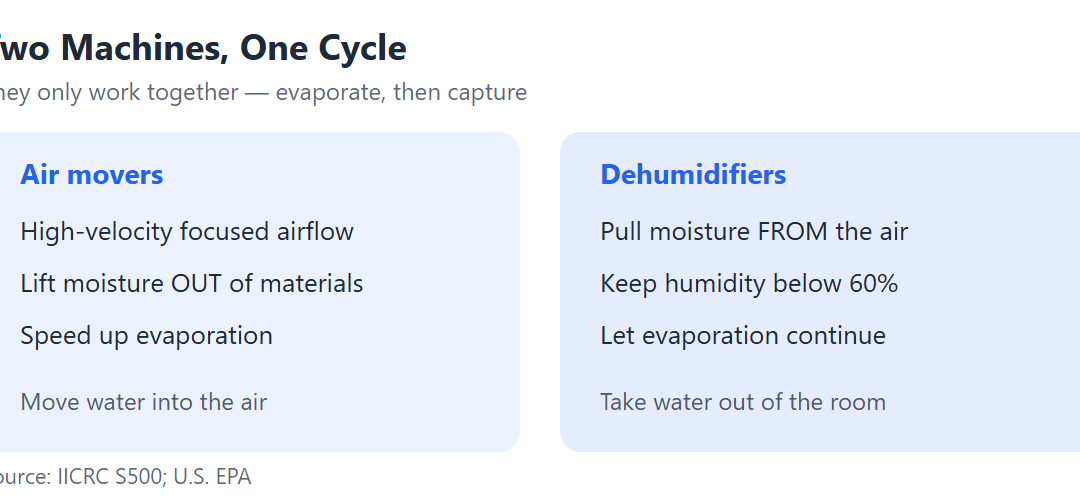
- Set up airflow with fans and a dehumidifier on the wet area.
- Check the condensate line and pan if you can safely reach the unit.
- Don’t ignore ceiling stains above an attic unit, even small ones.
If the water only touched a hard floor and you dried it within an hour, you’re probably fine to monitor. If it reached drywall, carpet, insulation, or the ceiling, treat it as a water-damage event, not just an AC repair.
How can DFW homeowners prevent AC water leaks?
The single best prevention step is an annual HVAC tune-up before summer, paired with regular condensate-line maintenance. Most overflow leaks trace back to a clogged line or a dirty coil, both of which routine service catches early.
A simple maintenance rhythm goes a long way. Change your air filter every 1-3 months so the coil doesn’t freeze. Flush the condensate line with a vinegar-and-water mix a couple of times during cooling season to kill algae. Keep the secondary drain pan clear. And consider installing a float switch or water alarm that shuts the system down automatically if the pan starts to fill, which is cheap insurance against a ceiling collapse.
When should you call a water damage restoration pro?
Call a professional whenever water has reached drywall, ceilings, insulation, or flooring, or when you see staining, sagging, or smell mustiness. At that point the concern isn’t the AC anymore, it’s hidden moisture and the 24-48 hour mold clock.
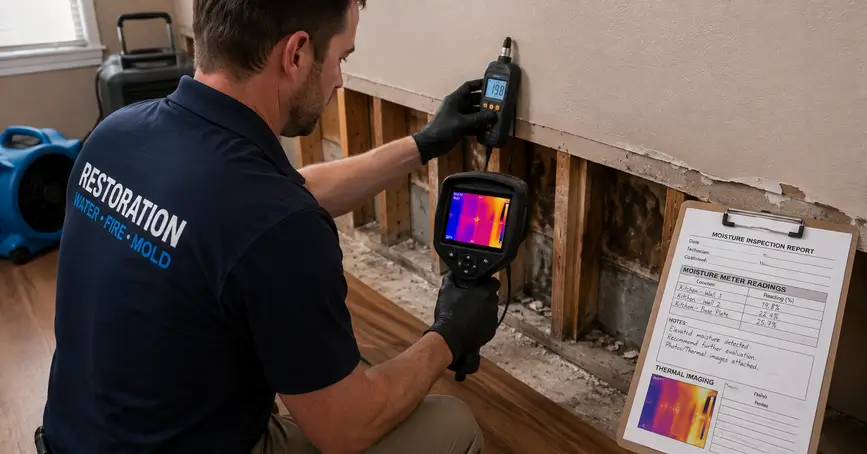
A restoration team uses moisture meters and thermal imaging to map how far the water actually traveled, which is almost always farther than the visible stain. If your AC has damaged a ceiling or wall, our team handles professional water damage restoration across DFW, and you can schedule a free inspection to find out how deep the moisture goes before mold sets in.
Frequently Asked Questions
Is a leaking AC an emergency?
It depends on volume and location. A few drops on a tile floor isn’t urgent, but water reaching a ceiling, drywall, or insulation is, because materials not dried within 24-48 hours are at real risk of mold (EPA). When in doubt, shut the unit off and dry the area immediately.
How long until mold grows from an AC leak?
The EPA advises that drying wet materials within 24-48 hours usually prevents mold; left damp past that window, mold is likely to grow. Attic-mounted units are especially risky because saturated insulation holds moisture against the ceiling, extending the wet window well past that threshold if it isn’t dried quickly.
Will homeowners insurance cover AC leak water damage?
Many policies cover sudden, accidental water damage but exclude damage from long-term leaks or poor maintenance. Coverage varies, so review your policy and document everything. Our guide on filing a water damage insurance claim in Texas walks through the process.
Can I just put a bucket under the leak?
Only as a very short-term stopgap. A bucket catches dripping water but does nothing about the moisture already in your ceiling or walls, where mold actually grows. Shut the system off and address the source and the wet materials, not just the drip.
Conclusion
An air conditioner leaking water inside is rarely “just condensation.” In most DFW homes it points to a clogged condensate line or full drain pan, and because so many units sit in attics, the damage often shows up as a ceiling stain only after the materials above have been wet for days.
- The most common cause is a clogged condensate drain line.
- Drying within 24-48 hours usually prevents mold, so speed is everything.
- The leak repair is cheap; the hidden water damage is what costs.
- When water reaches drywall, ceilings, or insulation, call a pro.
If your AC has already caused a stain, sag, or musty smell, don’t wait it out. Schedule a free DFW inspection and we’ll find the moisture before it turns into mold.
Sources
- Service Champions, “My Air Conditioner Is Leaking Water,” retrieved 2026-06-18, https://www.servicechampions.net/blog/my-air-conditioner-is-leaking-water-why-its-leaking-and-what-to-do
- U.S. EPA, “A Brief Guide to Mold, Moisture and Your Home,” retrieved 2026-06-18, https://www.epa.gov/mold/brief-guide-mold-moisture-and-your-home
- HomeGuide, “How Much Does AC Repair Cost? (2026),” retrieved 2026-06-18, https://homeguide.com/costs/ac-repair-cost
- Ace Cooling, Heating, Plumbing & Electrical, “How Much Do Air Conditioner Leak Costs To Repair?,” retrieved 2026-06-18, https://acehomeaz.com/blog/how-much-do-air-conditioner-leak-costs-to-repair/