

Water is dripping through your apartment ceiling, and the first question isn’t “how do I clean this up?” — it’s “who’s paying for it?” In a Texas rental, the answer depends on one thing more than any other: what caused the damage, and whether you reported it. Get that wrong and you could be on the hook for a repair that was never yours to cover.
This guide breaks down who’s responsible for water damage in a Texas rental, what renters insurance actually covers, and how fast your landlord is legally required to act.
Key Takeaways
- In Texas, a landlord must make a diligent effort to repair conditions that materially affect a tenant’s health or safety — but only after the tenant gives notice and is current on rent (Texas State Law Library).
- Tenants can be held liable when the damage is their fault or when they failed to report a known leak.
- Renters insurance covers your belongings from sudden, accidental water damage — not the building structure (the landlord’s job) and not flooding.
- Documenting the damage immediately — photos plus written notice — is what decides most disputes.
This article is general information, not legal advice. For your specific situation, consult an attorney or the Texas State Law Library’s resources.
Who Is Responsible for Water Damage in a Texas Rental?
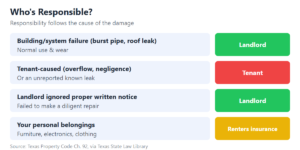
Responsibility comes down to cause. As a rule, the landlord owns repairs to the building and its systems, while the tenant owns damage they caused and their own belongings. Texas law requires a landlord to make a diligent effort to repair a problem that “materially affects the physical health or safety of an ordinary tenant” — a category that includes roof leaks and sewage backups (Texas State Law Library).
So who pays? If a pipe in the wall bursts or the roof leaks, that’s the landlord’s repair. If you overflow the tub or leave a known leak unreported until it rots the floor, that shifts to you. The dividing line is fault plus notice — not who happened to be standing there when the water appeared.
Related: our water damage restoration services for DFW rentals and multi-unit properties.
What Are the Landlord’s Repair Obligations in Texas?
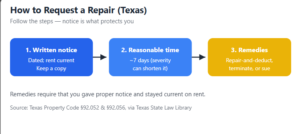
A Texas landlord’s core duty is set by the Texas Property Code: make a diligent effort to fix conditions that materially affect an ordinary tenant’s physical health or safety. Under Section 92.052, that duty kicks in only when specific conditions are met — the tenant is current on rent, has notified the landlord of the problem, and didn’t cause it themselves (Texas State Law Library).
Water intrusion usually clears that bar easily. A roof leak, a burst supply line, or a sewage backup all threaten health and safety, so the landlord must act. The catch is procedural: no notice, no obligation. That’s why your written notice — dated and specific — is the most important document in the whole dispute.
When Is the Tenant Responsible?
The tenant becomes responsible when the damage is their fault or their delay. If you or a guest cause the water damage — an overflowing bathtub, a fish tank, a hose left running — the landlord isn’t on the hook, and the cost can come out of your pocket or your deposit. The same is true if you knew about a leak and didn’t report it, letting a small drip become a rotted subfloor.
This is where fast reporting protects you financially. A leak you report on day one is the landlord’s problem to fix; the same leak you sit on for two weeks can become your liability. When water is clean at first but left to sit, it also turns dangerous — see our guide to the 3 water damage categories for why time changes everything.
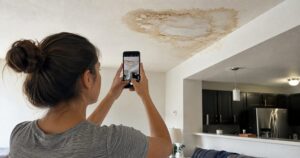
A tenant photographs a water-stained ceiling to document water damage before reporting the issue to the landlord in a Texas rental property.
Does Renters Insurance Cover Water Damage?
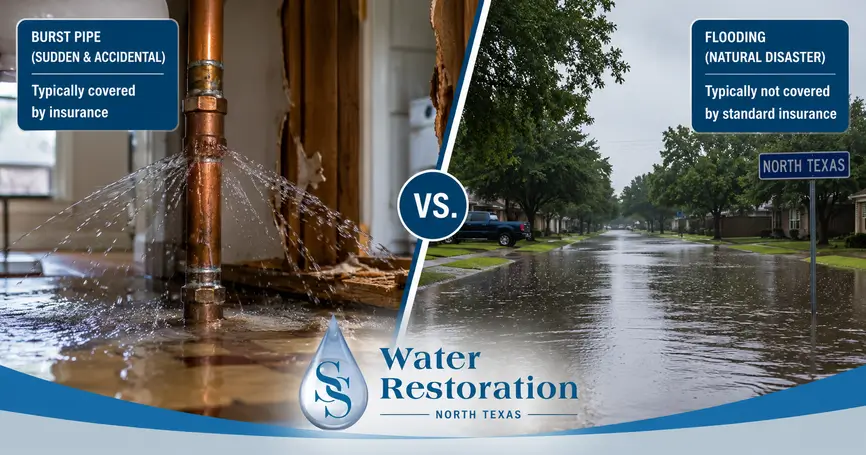
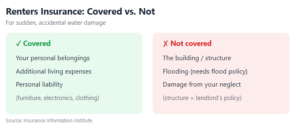
Renters insurance covers your stuff, not the structure. A standard renters policy pays to repair or replace your personal belongings after sudden, accidental water damage, and often covers additional living expenses if the unit becomes unlivable (Insurance Information Institute). What it does not cover is the building itself — that’s the landlord’s insurance — or flooding, which requires a separate flood policy.
That split surprises a lot of renters. Your landlord’s policy won’t replace your soaked couch, and your renters policy won’t fix the ceiling. Each side covers its own. It’s also why a landlord isn’t automatically liable for your belongings unless the damage resulted from their negligence.
How Fast Must a Landlord Fix Water Damage in Texas?
The standard is a “reasonable time,” and Texas law generally treats seven days as the benchmark. Under Section 92.056, a landlord has a reasonable period to make repairs after receiving notice, and the state library notes that “reasonable” is commonly read as seven days — though it can be shorter or longer depending on severity and the availability of labor and materials (Texas State Law Library).
Water damage often argues for the shorter end. Every day of delay makes it worse, because mold can begin growing within 24 to 48 hours of materials getting wet (EPA). If the landlord fails to make a diligent effort after proper notice, Texas tenants have remedies — repair-and-deduct, lease termination, or a lawsuit — but those depend on having followed the notice rules first. Knowing the early signs of water damage helps you report before it spreads.
What Should Tenants and Landlords Do Immediately?
Both sides should do the same two things first: stop the water and document everything. Shut off the source if you safely can, then photograph the damage before anything is moved or cleaned. For the tenant, that record backs your notice; for the landlord, it establishes the cause and scope for insurance.
Then move fast, because the cost curve is steep — one inch of water can cause up to $25,000 in damage (This Old House). Tenants: send written notice the same day and keep a copy. Landlords: line up mitigation immediately, because a delayed repair can both increase your liability and turn a simple dry-out into a mold problem. When it’s time to file, our guide to filing a water damage insurance claim in Texas walks through the documentation.
When Should a Landlord Call a Restoration Professional?
Landlords should call a pro the moment water reaches shared walls, ceilings, or multiple units — not after the drywall starts to sag. In multi-unit buildings, one upstairs leak can affect several tenants at once, and hidden moisture between units is exactly where mold takes hold and liability grows.
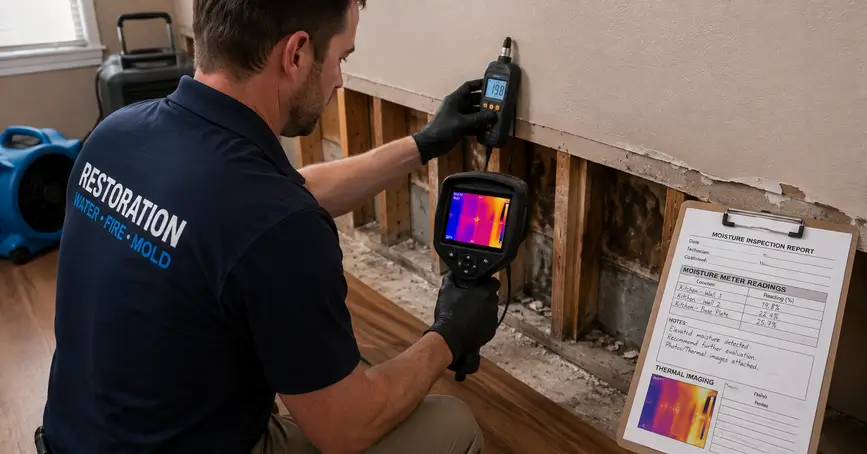
At SS Water Restoration, our IICRC-certified team finds hidden moisture with meters and thermal imaging, dries the structure properly, and documents everything for the insurance claim. If mold has already started, we handle mold remediation too. Founder Stephan Sannikov (license #RCO1659) works with DFW landlords and property managers across Collin and Denton County.
Managing a rental with water damage? Call SS Water Restoration 24/7 at (469) 737-0296 for a free North Texas inspection. We dry it right, document it for insurance, and help you limit liability.
Frequently Asked Questions
Is my landlord responsible for water damage in Texas?
Usually yes, if it affects your health or safety and you gave proper notice. Texas law requires landlords to make a diligent effort to repair conditions that materially affect an ordinary tenant, once you’re current on rent and have notified them, and didn’t cause the problem (Texas State Law Library).
Does renters insurance cover water damage?
It covers your personal belongings from sudden, accidental water damage — plus living expenses if you’re displaced — but not the building structure or flooding (Insurance Information Institute). The structure is the landlord’s responsibility, and flooding needs a separate flood policy.
Who pays for water damage — tenant or landlord?
It depends on the cause. Building failures like burst pipes or roof leaks are the landlord’s; damage you caused or a leak you failed to report can become yours. Your belongings are covered by your own renters insurance, not the landlord’s policy.
How long does a landlord have to fix water damage in Texas?
A “reasonable time,” generally treated as about seven days under Section 92.056, though severe problems may require faster action (Texas State Law Library). Because mold can start within 24–48 hours (EPA), water damage often warrants urgency.
Can a landlord charge a tenant for water damage?
Yes, if the tenant caused it or failed to report a known leak — the cost can come from the tenant or their deposit. Damage from normal use or building failure is not chargeable to the tenant. Documentation of the cause is what settles these disputes.
The Bottom Line for Texas Renters and Landlords
In a Texas rental, water damage responsibility follows the cause — and the paper trail. Here’s what to remember:
- Landlords must repair health-and-safety conditions like leaks after proper written notice (Texas Property Code Ch. 92).
- Tenants are liable when they caused the damage or ignored a known leak.
- Renters insurance covers your belongings; the landlord’s insurance covers the structure; flooding needs its own policy.
- Report in writing immediately and document with photos — it’s what decides who pays.
If you’re a DFW landlord or tenant dealing with water damage, call SS Water Restoration 24/7 at (469) 737-0296 for a free inspection and honest documentation.
Sources
- Texas State Law Library, Landlord/Tenant Law: Requesting Repairs (Texas Property Code §92.052 & §92.056), retrieved 2026-07-02, https://guides.sll.texas.gov/landlord-tenant-law/requesting-repairs
- Insurance Information Institute, Facts + Statistics: Homeowners and renters insurance, retrieved 2026-07-02, https://www.iii.org/fact-statistic/facts-statistics-homeowners-and-renters-insurance
- U.S. Environmental Protection Agency, A Brief Guide to Mold, Moisture and Your Home, retrieved 2026-07-02, https://www.epa.gov/mold/brief-guide-mold-moisture-and-your-home
- This Old House, Water Damage Statistics (citing FEMA), retrieved 2026-07-02, https://www.thisoldhouse.com/foundations/water-damage-statistics