

You did everything right — filed the claim, took some photos, waited — and the letter still says denied. It’s an infuriating spot to be in, especially with a wet house and a repair bill staring back at you. But a denial is not a final verdict. Most water damage claims are denied for a handful of predictable reasons, and several of them can be challenged with the right evidence.
This guide covers why water damage claims get denied, what to do the moment you get that letter, and the specific steps Texas homeowners can take to fight back.
Key Takeaways
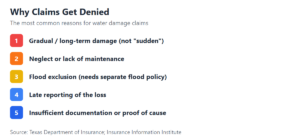
- Most denials come from a few reasons: gradual/long-term damage, “neglect,” the flood exclusion, late reporting, or insufficient documentation.
- A denial is not the end — you can request the reason in writing, add evidence, and formally dispute it.
- Professional moisture documentation (meters, thermal imaging, cause-of-loss reporting) often reverses “gradual damage” and “neglect” denials.
- Texas homeowners have real recourse: the policy’s appraisal process and the Texas Department of Insurance.
This article is general information, not legal or insurance advice. For your situation, consult an attorney or the Texas Department of Insurance.
Why Do Insurers Deny Water Damage Claims?
Most denials trace back to a short list of reasons, and knowing which one applies to you is the first step to responding. Insurers cover sudden and accidental water damage but exclude damage they consider gradual, preventable, or outside the policy — and water losses are common enough that they’re scrutinized closely. Water damage and freezing make up 22.6% of all home insurance claims, averaging $15,400 (Insurance Information Institute, 2025).
The Texas Department of Insurance lists the usual culprits — from damage the policy doesn’t cover to disputes over the amount (Texas Department of Insurance). Here are the ones that hit water claims most often.
“Gradual Damage” and “Neglect” — the Most Common Denials
These two reasons account for a huge share of denied water claims, and they hinge on one word: sudden. Insurers cover water damage that happens suddenly and accidentally — a pipe that bursts today. They deny damage they can argue built up slowly, like a slow leak that rotted a cabinet over months, calling it a maintenance issue you should have caught.
The problem is that the two can look identical after the fact. A burst supply line and a slow drip can leave similar-looking damage, and without evidence, the insurer’s “gradual” label sticks. This is exactly where documentation wins or loses the claim — and where knowing the signs of water damage and the water damage category helps establish that a loss was sudden, not neglected.
Flood Exclusion Denials
If your denial mentions “flood,” the issue isn’t your documentation — it’s your policy. Standard homeowners insurance excludes flooding entirely, so water that rose in from outside during a storm is denied unless you carry separate flood coverage. This is one of the most common and most misunderstood denials in North Texas after heavy rain.
It’s also the hardest to reverse, because it’s usually a correct application of the policy rather than a mistake. The fix is preventive, not reactive — understanding the difference before the storm.
What to Do the Moment You Get a Denial
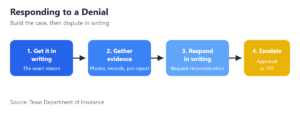
Slow down and build your case — don’t fire off an angry phone call. First, get the denial and its specific reason in writing; you can’t respond to a reason you don’t fully understand. Read your policy’s language on that reason, then gather everything that contradicts it: dated photos, receipts, maintenance records, and any professional assessment of the cause and timing of the loss.
Time still matters here, because the underlying damage keeps getting worse — mold can begin within 24 to 48 hours of materials getting wet (EPA). Document the current state, mitigate further damage, and keep every receipt. Then respond in writing with your evidence and request that the insurer reconsider.
How Professional Documentation Reverses Denials
Evidence is what turns “gradual damage” back into a covered “sudden” loss. When a restoration company documents a loss properly — moisture meter readings, thermal imaging of the wet area, and a written cause-of-loss assessment — it creates an objective record of what happened and when. That’s exactly the kind of proof that counters a vague “neglect” or “gradual” denial.
At SS Water Restoration, our IICRC-certified team documents every job this way as a matter of course, because we’ve seen thorough moisture mapping reverse denials that a few phone photos never could. Solid water damage restoration documentation protects both the repair and the claim — and it pairs with the records covered in our guide to filing a water damage insurance claim in Texas.
Texas Homeowner Remedies: Appraisal and the TDI
If the insurer won’t budge, Texas gives you a ladder of options. Many policies include an appraisal clause: you and the insurer each hire an appraiser, and the two select a third as umpire; their decision is binding on the amount of the loss (Texas Department of Insurance). You pay your appraiser and half the umpire’s cost, and your policy may set a deadline to demand it — so check the language.
Beyond appraisal, you can file a complaint with the Texas Department of Insurance, which can ask the company to re-examine its decision, and you can pursue mediation or, ultimately, a lawsuit (Texas Department of Insurance). TDI also runs a consumer Help Line at 800-252-3439.

When to Get Help
Bring in help when the amount is significant or the insurer keeps stonewalling. A restoration company gives you the objective moisture and cause-of-loss documentation that supports the claim. A public adjuster can represent your side of the valuation. And for a wrongful denial that won’t resolve, an attorney who handles insurance disputes is the last rung. Match the help to the size of the fight.
The single most valuable thing you can do, though, is get the loss documented properly from the start. At SS Water Restoration, founder Stephan Sannikov (license #RCO1659) leads an IICRC-certified team that dries your home and creates the record your claim depends on, across Collin and Denton County.
Fighting a denied water damage claim? Call SS Water Restoration 24/7 at (469) 737-0296 for a free North Texas inspection. We document the cause and moisture thoroughly — the evidence your appeal needs.
Frequently Asked Questions
Why was my water damage claim denied?
Most likely for one of five reasons: the insurer considered the damage gradual rather than sudden, blamed neglect or poor maintenance, applied the flood exclusion, cited late reporting, or found insufficient documentation (Texas Department of Insurance). Get the specific reason in writing to respond effectively.
Can I appeal a denied water damage claim?
Yes. Request the denial reason in writing, gather evidence that contradicts it, and ask the insurer to reconsider. If that fails, Texas homeowners can invoke the policy’s appraisal clause, file a complaint with the Texas Department of Insurance, or pursue mediation or a lawsuit (Texas Department of Insurance).
What is the appraisal process in Texas?
You and the insurer each hire an appraiser, and they choose a third as umpire; their decision binds the amount of the loss (Texas Department of Insurance). You pay your appraiser and half the umpire’s fee, and your policy may have a deadline to demand appraisal, so check it.
How do I dispute a denial with the Texas Department of Insurance?
File a complaint with the TDI, which can ask the insurer to re-examine its decision, or call the consumer Help Line at 800-252-3439 (Texas Department of Insurance). Keep copies of all correspondence and your evidence.
Can professional documentation reverse a denial?
Often, yes. Moisture-meter readings, thermal imaging, and a written cause-of-loss report create objective evidence that a loss was sudden, not gradual — directly countering the most common denial reasons. It’s far stronger than a few phone photos taken after the fact.
The Bottom Line for North Texas Homeowners
A denied water damage claim is a starting point, not the end. Here’s what to remember:
- Most denials are “gradual damage,” neglect, flood exclusion, late reporting, or thin documentation.
- Get the reason in writing, then respond with evidence — professional documentation is the strongest kind.
- Texas gives you real recourse: appraisal, a TDI complaint, mediation, or a lawsuit.
- The best defense is documenting the loss properly from day one.
If your DFW water damage claim was denied, call SS Water Restoration 24/7 at (469) 737-0296 for a free inspection and honest documentation.
Sources
- Texas Department of Insurance, Why would my home insurance claim be denied or not paid?, retrieved 2026-07-02, https://www.tdi.texas.gov/tips/why-would-my-home-insurance-claim-be-denied-or-not-paid.html
- Texas Department of Insurance, What if my insurance isn’t paying enough? (appraisal & dispute options), retrieved 2026-07-02, https://www.tdi.texas.gov/tips/disagree.html
- Texas Department of Insurance, How to get help with a homeowners or renters insurance complaint, retrieved 2026-07-02, https://www.tdi.texas.gov/consumer/homeowners-renters-insurance-complaint.html
- Insurance Information Institute, Facts + Statistics: Homeowners insurance, retrieved 2026-07-02, https://www.iii.org/fact-statistic/facts-statistics-homeowners-and-renters-insurance
- U.S. Environmental Protection Agency, A Brief Guide to Mold, Moisture and Your Home, retrieved 2026-07-02, https://www.epa.gov/mold/brief-guide-mold-moisture-and-your-home