

After the water is gone, the hard part begins. A floor can look and feel dry while the subfloor beneath it, the wall cavity behind it, and the framing inside it are still soaked. Point a box fan at it for a day and you’ll dry the surface and trap the rest — which is precisely how a water leak becomes a mold problem. Professional structural drying exists to pull moisture out of the materials themselves, not just off the surface.
Here’s what actually happens when pros dry a home, the equipment they use, and why it works when DIY fans don’t.
Key Takeaways
- Structural drying is a controlled science (psychrometry): balancing airflow, humidity, and temperature — not just pointing fans at wet walls.
- Air movers push moisture out of materials; dehumidifiers pull it out of the air. You need both, working together.
- Pros verify dryness with moisture meters and thermal imaging — they don’t guess — because trapped moisture behind “dry-looking” surfaces feeds mold.
- Speed is the whole point: the EPA says wet materials should be dried within 24–48 hours to prevent mold (EPA).
What Is Structural Drying?
Structural drying is the controlled removal of moisture from a building’s materials — the subfloor, drywall, framing, and insulation — back to their normal, dry condition. It’s the core of professional water restoration, governed by the IICRC S500 standard that restoration companies work to (IICRC). The goal isn’t a dry-looking room; it’s materials that measure dry all the way through.
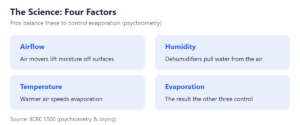
That distinction is everything. Water migrates into porous materials and hides, and left there it keeps causing damage and feeds mold. Real drying manages the physics of evaporation — the interplay of airflow, humidity, and temperature — to draw that hidden moisture out in a controlled way.
Why Aren’t Fans and Open Windows Enough?
Because they only touch the surface, and in Texas they can make things worse. A household fan moves a little air across the top of a wet floor, but it does nothing for the water soaked into the subfloor or trapped in a wall cavity. Open windows are worse in North Texas summers, where the outside air is often more humid than the inside — you’d be inviting moisture in, not letting it out.
The real problem is what you can’t see. Surface materials dry first and feel deceptively dry while moisture lingers underneath, right where it causes rot and mold. That’s why catching damage early and knowing the signs of water damage matters — and why professional drying targets the moisture you’d never reach with a fan.
Air Movers vs. Dehumidifiers: What Each Does
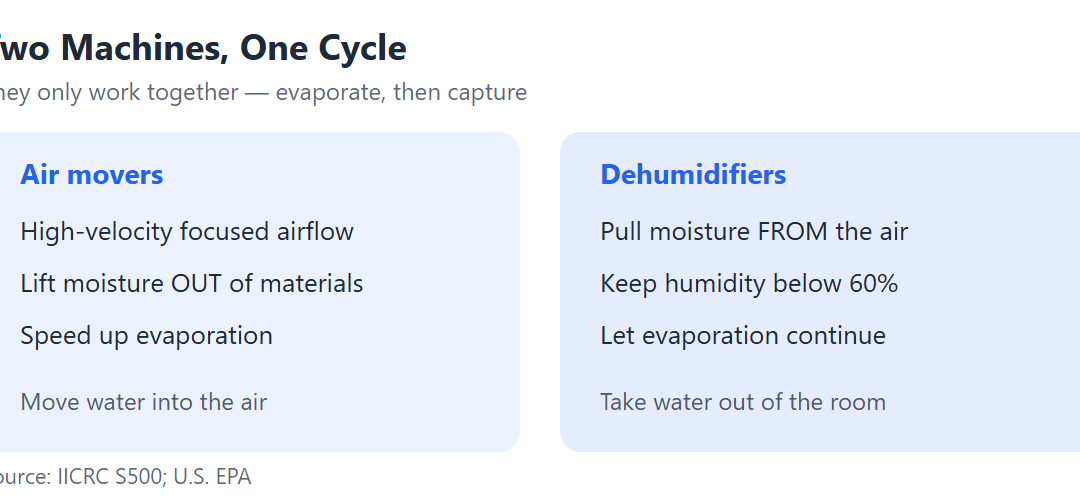
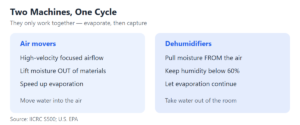
They do opposite, complementary jobs, and drying only works when both run together. An air mover is a high-velocity fan that pushes a focused sheet of air across wet surfaces, accelerating evaporation — it lifts moisture out of the materials and into the air. A dehumidifier then does the other half: it pulls that airborne moisture back out, keeping the room’s humidity low so evaporation can continue.
Run air movers alone and you just push moisture from the materials into the room air, where it re-absorbs into other surfaces. Run a dehumidifier alone and evaporation from the wet materials is too slow. Together, they create a cycle — evaporate, capture, repeat — that dries the structure from the inside out. The EPA recommends keeping indoor humidity below 60% to discourage mold (EPA), and that’s exactly what the dehumidifier maintains during drying.
How Do Pros Find and Track Moisture?
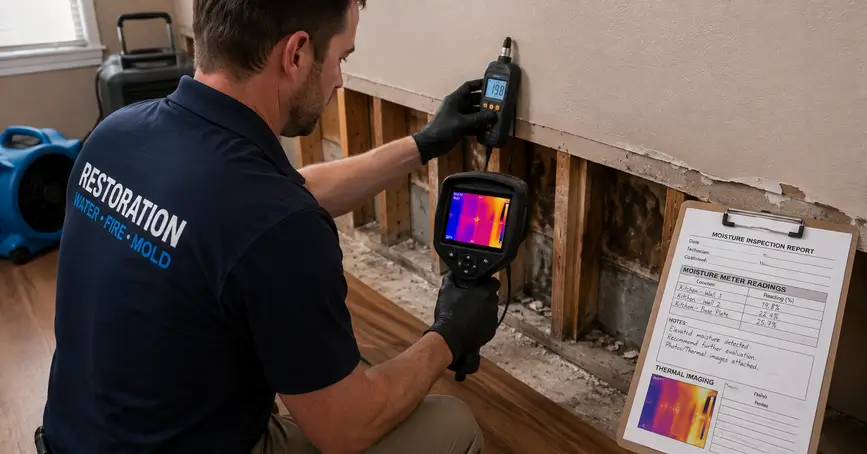
They measure it — they never guess. Before drying starts, technicians map the extent of the water with moisture meters that read the actual moisture content inside materials, and thermal imaging cameras that reveal cool, wet areas hidden behind walls and under floors. That map defines where the water went, which is often far beyond the visible wet spot.
Then they track it daily. A drying plan sets a target moisture content, and technicians take readings each day to confirm the materials are actually drying, adjusting equipment as needed. The job isn’t “done” when the floor feels dry — it’s done when the meters hit the dry standard. This is also where the water damage category matters, because contaminated water changes what can be dried versus what must be removed.
The Drying Process, Step by Step
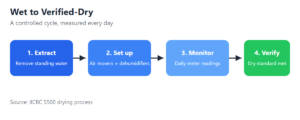
Professional drying follows a repeatable cycle from wet to verified-dry. It starts with extraction — removing every bit of standing water, because you can’t evaporate a puddle efficiently. Then technicians set the equipment: air movers positioned to sweep the wet surfaces and dehumidifiers sized to the space. From there it monitors and adjusts daily until the readings confirm the structure is dry.
How Long Does Structural Drying Take?
Most homes dry in about three to five days, though it varies with how much water there was, the materials involved, and the humidity. Dense materials like hardwood and plaster hold moisture longer than drywall, and a saturated subfloor takes longer than a damp carpet. The equipment runs continuously during that window — pulling it too early is a common way DIY drying fails.
The clock is the reason to start fast, not to rush the finish. Because mold can begin within 24 to 48 hours of materials getting wet (EPA), the sooner professional drying starts, the less damage sets in. For how the full restoration timeline fits together, see our guide to how long water damage restoration takes in DFW.
Why the Category and Speed Matter
Drying is only part of the job — what you’re drying matters just as much. Clean water can often be dried in place, but gray or black water contaminates the materials it touches, and those usually have to be removed rather than dried. Get that call wrong and you “dry” contamination back into the home. Speed compounds everything: the longer materials stay wet, the more the water spreads, degrades, and grows mold — and the bigger the bill, since one inch of water can cause up to $25,000 in damage (This Old House).
This is why professional water damage restoration isn’t just equipment rental — it’s the judgment to dry what can be saved, remove what can’t, and verify the result. If mold already took hold before drying began, mold remediation becomes part of the work.
Water damage that needs real drying? Call SS Water Restoration 24/7 at (469) 737-0296 for a free North Texas inspection. Our IICRC-certified team dries the structure — not just the surface — and proves it with moisture readings.
Frequently Asked Questions
How do professionals dry out water damage?
They use air movers to accelerate evaporation from wet materials and dehumidifiers to pull that moisture out of the air, working together in a controlled cycle. Technicians map the moisture with meters and thermal imaging, then monitor daily until readings confirm the structure is dry to the IICRC S500 standard (IICRC).
What’s the difference between an air mover and a dehumidifier?
An air mover is a high-velocity fan that lifts moisture out of materials and into the air. A dehumidifier removes that moisture from the air to keep humidity low. Air movers speed evaporation; dehumidifiers capture what evaporates — you need both for drying to work.
Why can’t I just use fans to dry water damage?
Household fans only dry the surface, leaving moisture trapped in the subfloor and wall cavities where it causes rot and mold. In humid North Texas, open windows can even add moisture. Because mold can start within 24–48 hours (EPA), incomplete drying is how leaks become mold problems.
How do pros know when the structure is dry?
They measure it. Technicians set a target moisture content and take daily readings with moisture meters, confirming materials have reached the dry standard rather than just feeling dry. The job is complete when the meters — not the surface — say so.
How long does professional drying take?
Usually about three to five days, depending on how much water there was, the materials, and the humidity. Dense materials like hardwood dry slower than drywall. The equipment runs continuously the whole time; stopping early is a common reason DIY drying fails.
The Bottom Line for North Texas Homeowners
Drying a home right is a controlled process, not a couple of fans and hope. Here’s what to remember:
- Structural drying removes moisture from the materials, not just the surface.
- Air movers and dehumidifiers work as a pair — evaporate, then capture.
- Pros measure moisture with meters and thermal imaging and verify the dry standard.
- Start fast: mold begins in 24–48 hours, and contaminated water changes what can be saved.
If your DFW home has water damage that needs to be dried right, call SS Water Restoration 24/7 at (469) 737-0296 for a free inspection.
Sources
- IICRC, S500 Standard for Professional Water Damage Restoration (drying principles, psychrometry), retrieved 2026-07-02, https://iicrc.org/s500/
- U.S. Environmental Protection Agency, A Brief Guide to Mold, Moisture and Your Home (24–48 hr drying; humidity below 60%), retrieved 2026-07-02, https://www.epa.gov/mold/brief-guide-mold-moisture-and-your-home
- This Old House, Water Damage Statistics (citing FEMA), retrieved 2026-07-02, https://www.thisoldhouse.com/foundations/water-damage-statistics