

To your insurance company, a burst pipe and a flooded street are two entirely different events — and only one of them is covered by your homeowners policy. Every year, DFW families discover this the hard way: after a storm pushes water into the house, they file a claim, and it gets denied because their policy excludes flooding. The water looked the same. The coverage wasn’t.
This guide explains the difference between water damage and a flood, why it decides whether you’re covered, and whether you need separate flood insurance in North Texas.
Key Takeaways
- Insurance draws a hard line: sudden, internal water damage (a burst pipe) is usually covered by homeowners insurance; rising external water (a flood) is not.
- Flooding requires a separate policy — the federal NFIP or private flood insurance.
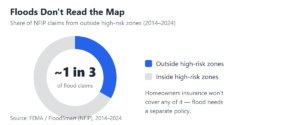
- Flood risk isn’t just for the coast: from 2014–2024, nearly one-third of NFIP flood claims came from outside high-risk flood zones (FEMA).
- Knowing which category your loss falls under — before disaster strikes — is what prevents a denied claim.
What’s the Difference Between Water Damage and a Flood?
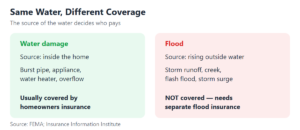
The line is where the water came from. Insurers generally define “water damage” as sudden, accidental water originating inside your home — a burst pipe, an overflowing appliance, a failed water heater. A “flood” is rising surface water that comes from outside and affects the ground: storm runoff, an overflowing creek, flash flooding. That distinction is small in your living room and enormous on your claim.
Officially, a flood is defined as a general and temporary condition of partial or complete inundation of normally dry land from overflowing or rapidly accumulating runoff (FEMA). If the water rose up from outside and in, it’s a flood. If it escaped from your own plumbing, it’s water damage.
Does Homeowners Insurance Cover Water Damage?
Usually, yes — when it’s sudden and accidental. A pipe that bursts, a water heater that ruptures, or an appliance that overflows is typically covered by a standard homeowners policy. What’s generally not covered is damage from gradual leaks or lack of maintenance, which insurers treat as neglect. Water damage is a common and costly claim: water damage and freezing make up 22.6% of all home insurance claims, averaging $15,400 (Insurance Information Institute, 2025).
So the internal, sudden stuff is covered. For the details on what qualifies and how to document it, our guide to understanding water damage insurance coverage breaks it down. But there’s one category your homeowners policy almost certainly won’t touch — flooding.
Why Doesn’t Homeowners Insurance Cover Floods?
Because flood risk is so large and concentrated that private homeowners policies exclude it by design. Standard homeowners insurance policies exclude flood damage entirely (FEMA). To fill that gap, the federal government created the National Flood Insurance Program (NFIP) in 1968, so homeowners could buy flood coverage separately.
This is the single most misunderstood point in home insurance. Homeowners assume “I have insurance, I’m covered” — right up until a storm sends water in from the yard and the adjuster points to the flood exclusion. The water damage from your dishwasher is covered; the identical-looking water from the street is not, unless you carry flood insurance.
What Is NFIP Flood Insurance, and Do You Need It in DFW?
The NFIP is federal flood insurance available to homeowners in participating communities, with coverage up to $250,000 for the building and $100,000 for contents (FEMA). Private flood insurance is also increasingly available. Whether you “need” it isn’t only about your flood-zone designation — it’s about your actual risk, and in flash-flood-prone North Texas, that risk is real even away from rivers.
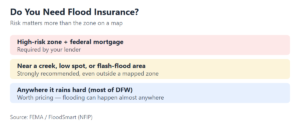
Lenders require flood insurance for homes in high-risk zones with a federally backed mortgage. But plenty of DFW homeowners outside those zones skip it — and that’s where people get caught, as the next section shows. (We serve homeowners across the entire DFW service area, much of which sees flash flooding well outside mapped zones.)
Flood Risk Outside the Flood Zone
You don’t have to live in a mapped flood zone to flood. This is the statistic every Texas homeowner should know: from 2014 to 2024, nearly one-third of NFIP flood insurance claims came from properties outside high-risk flood areas (FEMA). Flooding follows rainfall and terrain, not the boundaries on an insurance map.
North Texas is a textbook case. Fast, heavy downpours overwhelm storm drains and turn streets into rivers in minutes, and homes nowhere near a creek take on water. If your only coverage is a homeowners policy, that water is a denied claim. The map says “low risk”; the weather doesn’t always agree.
What to Do If You’re Already Dealing With Water or Flood Damage
Act fast and document relentlessly — regardless of which category it turns out to be. Stop the source if it’s internal, move valuables up and out of the water, and photograph everything before you touch it. Those photos establish the cause of loss, which is exactly what determines coverage, and our guide to filing a water damage insurance claim in Texas covers the paperwork. Time is not on your side: one inch of water can cause up to $25,000 in damage (This Old House), and mold can start within 24–48 hours.
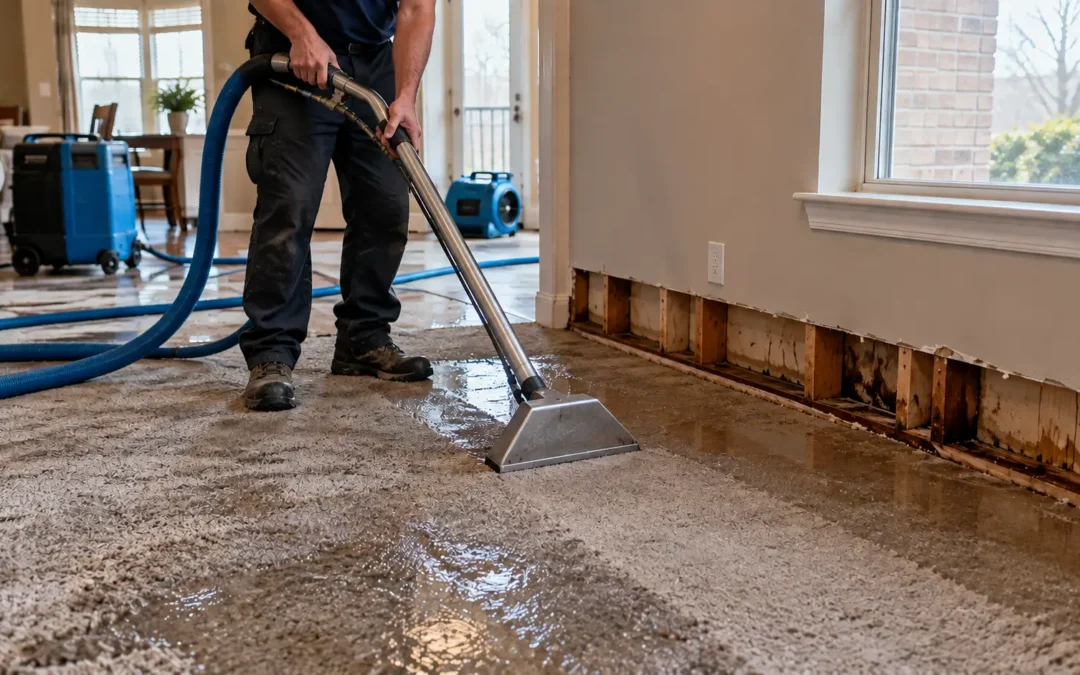
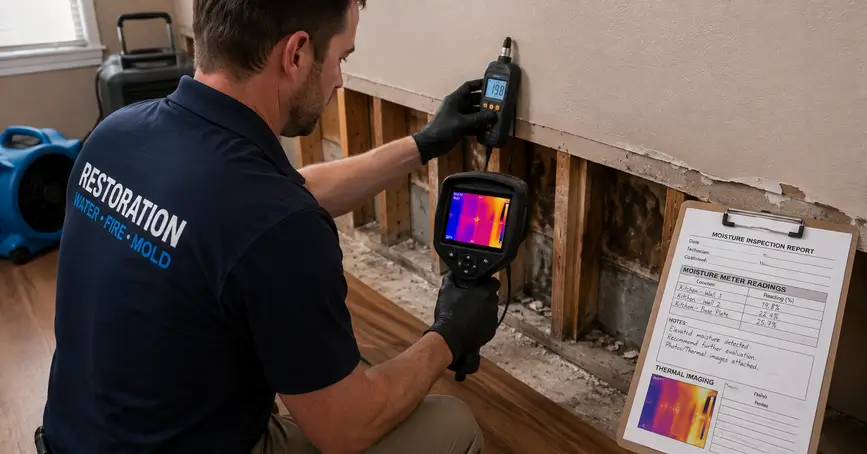
Then get the structure dried properly. Whether your claim runs through homeowners or a flood policy, the water damage restoration work is the same — find the hidden moisture, dry it, and stop mold before it starts. The category also shapes safety: floodwater is often contaminated Category 3 water, as explained in our guide to the 3 water damage categories.
How to Avoid a Coverage Gap
The fix is simple and it’s a phone call. Before storm season, review your homeowners policy, confirm what water damage it covers, and ask your agent directly: “Am I covered for flooding, and if not, what would a flood policy cost?” There’s typically a waiting period before flood coverage takes effect, so this is a before-the-storm task, not a during-the-storm one.
At SS Water Restoration, we’ve dried out too many DFW homes whose owners assumed they were covered. Founder Stephan Sannikov (license #RCO1659) leads an IICRC-certified team serving Collin and Denton County — and we’ll document your loss thoroughly no matter which policy it falls under.
Storm or pipe put water in your home? Call SS Water Restoration 24/7 at (469) 737-0296 for a free North Texas inspection. We dry it right and document everything for your claim.
This article is general information, not insurance advice — confirm your specific coverage with your agent.
Frequently Asked Questions
Does homeowners insurance cover flood damage?
No. Standard homeowners policies exclude flooding — rising external water — entirely (FEMA). Flood damage requires a separate policy through the NFIP or a private flood insurer. Homeowners insurance covers sudden internal water damage, like a burst pipe, but not a flood.
What’s the difference between water damage and a flood?
Source. Water damage originates inside the home (burst pipe, appliance, water heater) and is usually covered by homeowners insurance. A flood is rising surface water from outside — storm runoff, an overflowing creek — which is excluded and needs separate flood insurance.
Do I need flood insurance in DFW?
It’s worth pricing even outside a high-risk zone. From 2014–2024, nearly one-third of NFIP claims came from outside high-risk areas (FEMA). North Texas flash flooding puts homes far from creeks at risk, so ask your agent about coverage and cost.
Is a burst pipe considered a flood?
No. A burst pipe is sudden internal water damage, typically covered by homeowners insurance. “Flood” specifically means rising water from outside the home. The two look similar but fall under completely different coverage.
How much flood insurance can I get?
Through the NFIP, up to $250,000 for the building and $100,000 for contents (FEMA). Private flood insurance may offer higher limits. Coverage is available to homeowners in the roughly 22,600 participating NFIP communities.
The Bottom Line for North Texas Homeowners
The difference between “water damage” and “flood” is the difference between a paid claim and a denied one. Here’s what to remember:
- Homeowners insurance covers sudden internal water damage — not flooding.
- Flooding needs a separate NFIP or private flood policy.
- Nearly one-third of flood claims come from outside high-risk zones — the map isn’t the whole story.
- Review your policy and ask about flood coverage before storm season, not after.
If water has entered your DFW home from any source, call SS Water Restoration 24/7 at (469) 737-0296 for a free inspection.
Sources
- FEMA, Flood Insurance (flood definition; homeowners exclusion; NFIP), retrieved 2026-07-02, https://www.fema.gov/flood-insurance
- FEMA / FloodSmart (National Flood Insurance Program), What Is My Flood Risk and program overview (claims outside high-risk zones; coverage limits), retrieved 2026-07-02, https://www.floodsmart.gov/flood-zones-and-maps/what-is-my-flood-risk
- Insurance Information Institute, Facts + Statistics: Homeowners insurance, retrieved 2026-07-02, https://www.iii.org/fact-statistic/facts-statistics-homeowners-and-renters-insurance
- This Old House, Water Damage Statistics (citing FEMA), retrieved 2026-07-02, https://www.thisoldhouse.com/foundations/water-damage-statistics