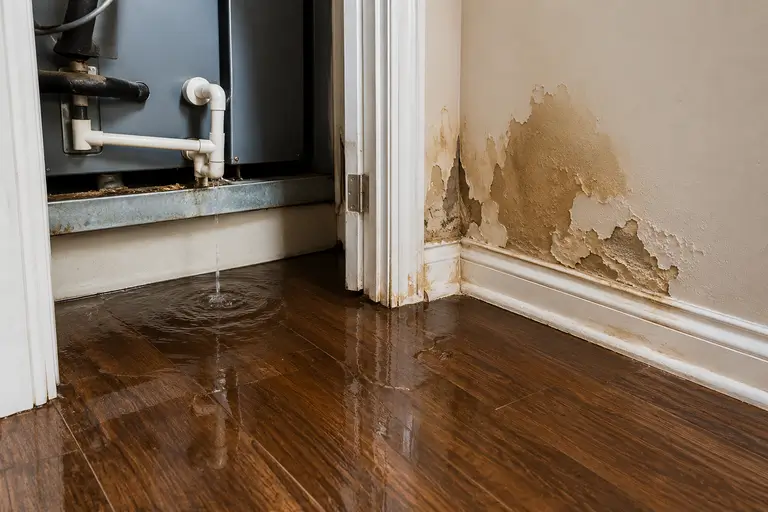


In 2024, 97.9% of all new single-family homes in Texas and the surrounding West South Central states were built on slab foundations, according to the NAHB and U.S. Census Bureau Survey of Construction published in August 2025. That number isn’t surprising if you’ve lived in DFW for more than a few years — virtually every home here sits on concrete, with the water lines that supply every sink, shower, toilet, and appliance running through or beneath that slab.
Slab leak water damage in North Texas is one of the most common — and most misunderstood — water damage scenarios restoration companies respond to. When one of those lines fails, there’s no crawlspace to absorb the water. It goes directly into the concrete, and then into whatever floor is above it. Most DFW homeowners call a plumber when a slab leak is confirmed, get the pipe fixed, and believe the job is done. The water damage that soaked into flooring, base plates, and wall cavities while the leak ran is a completely separate scope — and it needs a completely different contractor.
This guide covers what a slab leak is, why North Texas homes are especially vulnerable, how to recognize one early, the two-contractor workflow most homeowners don’t know about, what Texas homeowners insurance actually covers, restoration cost ranges, and how fast mold develops once the leak starts.
Key Takeaways
- In 2024, 97.9% of new single-family homes in Texas were built on slab foundations — virtually all DFW homes have water lines running through or beneath the concrete (NAHB / U.S. Census Bureau, August 2025).
- A slab leak requires two separate contractors: a licensed plumber to locate and repair the pipe, and an IICRC-certified restoration company to address the water damage. Most homeowners call only one.
- Texas homeowners insurance covers the restoration scope and typically the concrete access cost — but not the pipe repair itself, and not mold remediation above the $5,000–$25,000 sub-limit on most policies.
- The EPA’s 24–48 hour mold-prevention window applies fully to slab leaks. Water trapped under flooring and at base plates in a DFW home in summer can produce visible mold colonization within 48–72 hours.
What Is a Slab Leak and Why Are DFW Homes So Vulnerable?
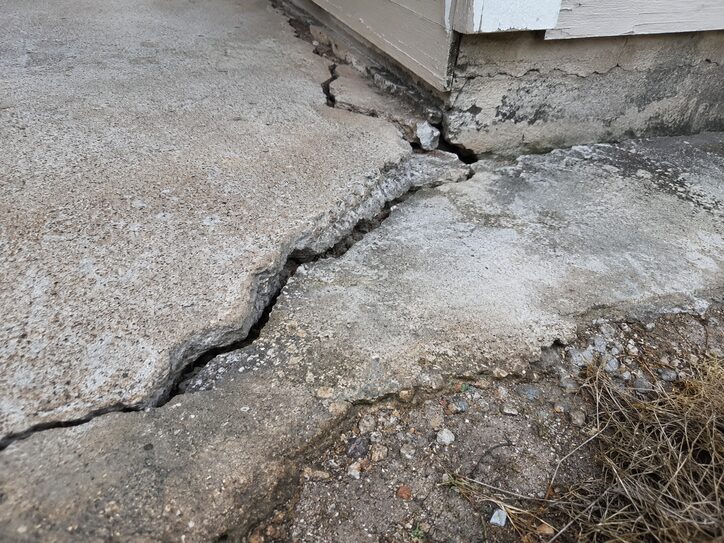
Cracked and weathered concrete at the base of a home shows signs of moisture damage, erosion, and structural deterioration.
In 2024, 97.9% of all new single-family homes in the West South Central division — Texas, Oklahoma, Arkansas, and Louisiana — were built on slab foundations, according to the NAHB and U.S. Census Bureau Survey of Construction. Nationally, 73% of new homes started in 2024 used slab construction, up from 45.8% in 2000. In DFW specifically, slab construction is effectively universal for any home built in the past 60 years. The water lines that supply every fixture in those homes — cold supply, hot supply, sometimes drain lines — run through or directly beneath the concrete. When those lines fail, there’s nowhere for the water to go but up into the building.
A slab leak is any leak in a pressurized water line that runs through or beneath a concrete foundation. The leak may be in a supply line under active pressure, producing a steady flow of water, or in a drain line, producing slower but persistent moisture. In either case, the water migrates laterally through and around the concrete before it wicks upward through the slab into whatever material is above it — tile adhesive, hardwood flooring glue, LVP underlayment, carpet padding.
DFW homes are particularly vulnerable for three reasons. First, the housing stock age: most DFW homes were built between 1965 and 2005, when copper was the standard pipe material. Copper lines have a service life of 50–70 years. A significant portion of DFW’s housing stock is entering or already past that range. Second, DFW’s clay soil creates relentless seasonal movement that stresses every joint and elbow in the underground lines — the mechanism covered in the next section. Third, North Texas municipal water supplies, while safe, carry dissolved minerals and chloramine compounds that accelerate interior copper corrosion over decades.
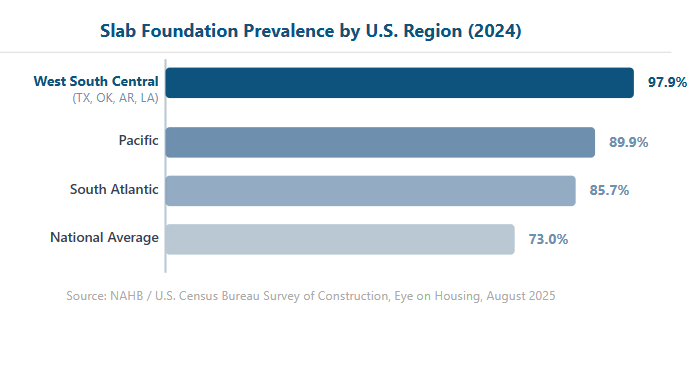
Caption: Texas’s 97.9% slab construction rate is nearly universal — virtually every DFW home has water lines running through or beneath concrete, with no crawlspace buffer between a pipe failure and the living space above. Source: NAHB / U.S. Census Bureau, August 2025.
For a full overview of our water damage restoration process after a slab leak is confirmed, see our main services page.
How Does North Texas Clay Soil Make Slab Leaks More Likely?
According to USGS and ASCE research on expansive soils, approximately 25% of all U.S. homes have damage caused by shrink-swell clay, and annual losses from expansive soil movement exceed those caused by earthquakes, floods, hurricanes, and tornadoes combined. In North Texas, the Blackland Prairie’s Vertisol clay is among the most expansive soil types in the country — and it underlies the foundations of most DFW homes built before 2010.
What makes Blackland Prairie clay so destructive to slab foundations is the seasonal dry-wet cycle that’s unique to the DFW climate. During summer droughts, the clay shrinks and pulls away from the foundation, allowing the slab to settle and shift. When fall and winter rains arrive, the clay reabsorbs water and expands dramatically, pushing the slab from below. Each cycle moves the concrete — and every joint, elbow, and coupling in the copper lines running through it absorbs that movement. Over time, repeated stress at those connection points causes metal fatigue and, eventually, failure.
This mechanism is different from what drives slab leaks in Houston (where land subsidence from groundwater extraction is the primary culprit) or San Antonio (where karst limestone geology creates void formation beneath foundations). In DFW, the pipe failure mechanism is explicitly cyclical — the same weather pattern that makes DFW’s summers brutal also makes the underground plumbing progressively more vulnerable with every passing year.
The practical implication: slab leaks in DFW aren’t one-time bad luck. A home with one copper slab leak has the same underlying soil conditions and the same copper pipe system as it did before the repair. If the root cause is clay-driven movement rather than a single manufacturing defect, additional leaks are statistically likely — especially on any remaining copper lines in the same system.
Two of the most common hidden water damage sources in North Texas — slab leaks and AC condensate drain overflows — are both driven by DFW’s seasonal climate extremes. Neither is visible until the damage is already underway.
What Are the Warning Signs of a Slab Leak in a DFW Home?
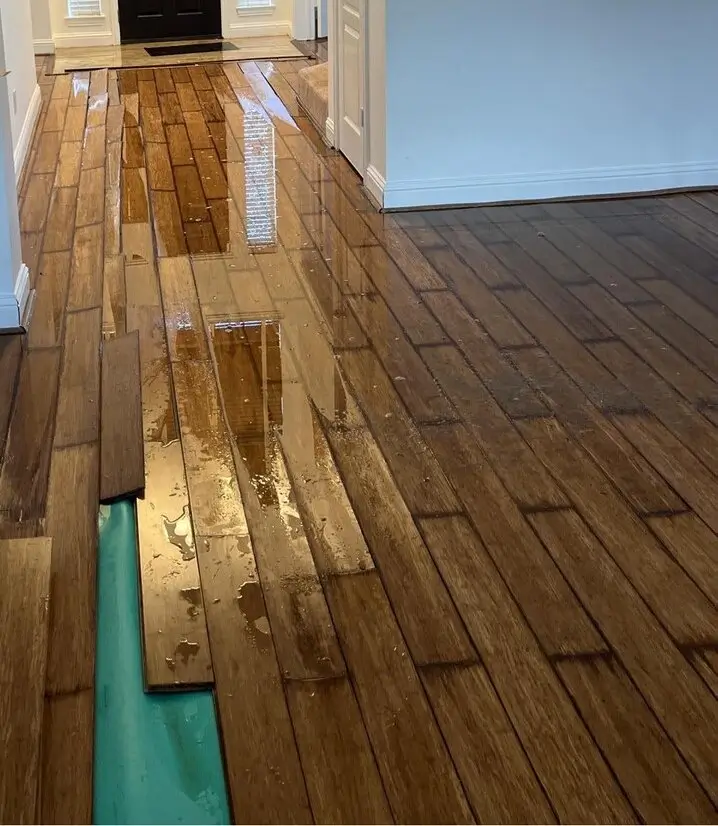
Standing water and warped flooring show significant interior water damage in a residential hallway.
Based on SS Water Restoration’s intake data from slab leak jobs across DFW, most homeowners confirm the leak after the damage is already visible — meaning the pipe had been running for days, and sometimes weeks, before anyone made the call. Early detection is the single largest cost variable in slab leak restoration. Catching it at the symptom stage, before flooring fails, is the difference between a $280 plumber detection visit and a full restoration scope averaging $3,864 nationally (HomeAdvisor, October 2025).
These are the six warning signs that appear before the damage becomes visible:
- Unexplained increase in the water bill. A 10–30% spike with no change in usage, no new appliances, and no visible leak elsewhere in the house is a reliable early indicator. The meter is measuring real flow. Call your plumber before anything else becomes apparent.
- Sound of running water when all fixtures are off. This is most detectable at floor level in quiet rooms, and especially noticeable at night when the house is otherwise silent. The sound typically comes from beneath hardwood or tile flooring over the slab area where the leak is active.
- Warm or hot spots on the floor. Hot water line leaks heat the concrete above them. In tile and hardwood homes, this is detectable by walking barefoot or with a thermal imaging camera. A hot spot in an unexpected area of the floor — not above any radiant heat element — warrants investigation.
- Soft, damp, or buckling flooring. Water migrating upward through the slab saturates LVP glue, swells hardwood planks, and undermines tile adhesive. Buckling, cupping, or soft spots in flooring with no visible moisture source above are almost always a slab or subfloor moisture problem.
- New cracks in interior drywall or exterior brick mortar. Slab movement from below produces the same diagonal crack patterns in drywall and masonry that foundation movement does. A new crack appearing without an obvious cause — especially in a home that had no prior cracking issues — may indicate saturated soil beneath the slab.
- Musty smell at floor level. By the time this is detectable, moisture has been present long enough for biological activity to begin. A consistent musty odor at the base of walls or under flooring indicates at least 48–72 hours of sustained moisture — the EPA’s mold-prevention window has likely already closed.
Stephan Sannikov, SS Water Restoration’s IICRC-certified founder (License #RCO1659), notes that in the majority of slab leak jobs the team responds to across DFW, at least two of these warning signs were present and noticed by the homeowner before the visible damage appeared — but attributed to something else. The water bill spike was blamed on a running toilet. The floor sound was assumed to be the house settling. By the time the connection was made, the scope had already grown significantly.
What’s the Difference Between a Plumber’s Scope and a Restoration Contractor’s Scope?
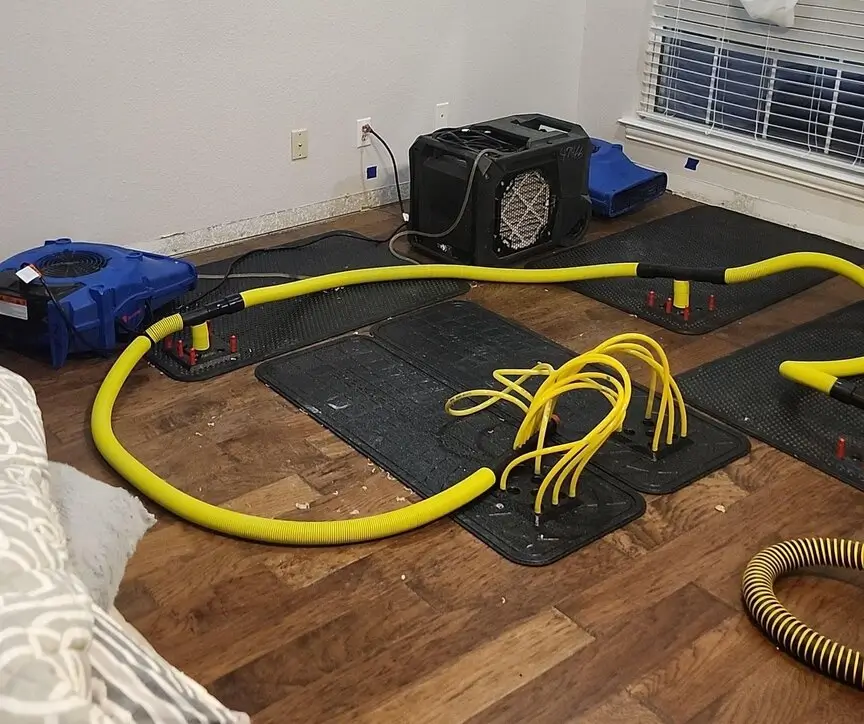
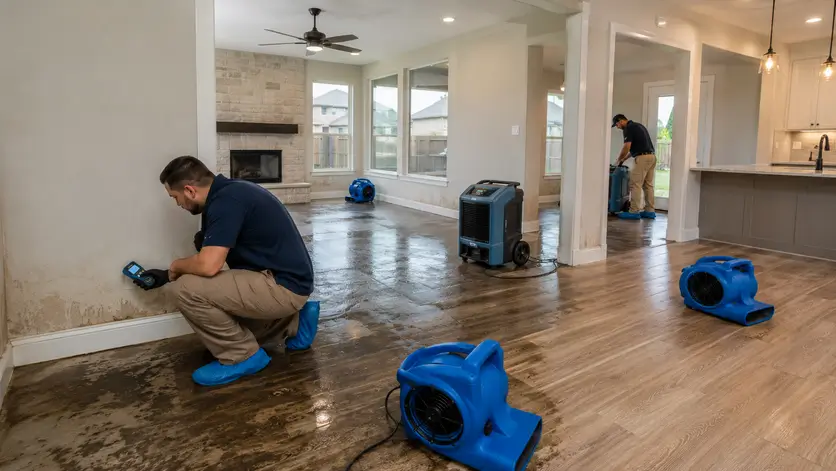
Professional water mitigation equipment is being used to dry moisture-damaged flooring in a residential room.
In October 2025, HomeAdvisor reported the national average water damage restoration cost at $3,864 — a figure that covers the restoration contractor’s scope only, with the plumber’s $630–$4,400 repair invoice entirely separate. Those are two distinct jobs, two distinct contractors, and two distinct line items on an insurance claim. Most DFW homeowners call only one.
A plumber fixes the pipe. A water damage restoration contractor addresses everything the water touched after the pipe failed. Those are entirely different scopes of work, on entirely different invoices, covered under entirely different provisions of your homeowners insurance policy. The single most common mistake DFW homeowners make after a slab leak is calling only one.
The plumber’s scope:
- Locate the leak using electronic detection equipment, acoustic listening devices, or pressure testing
- Excavate or access the pipe — either by jackhammering through the interior slab floor or accessing from the exterior perimeter
- Repair or replace the failed pipe section, or reroute the line above-slab if direct repair isn’t feasible
- Restore the concrete opening with new concrete pour
The restoration contractor’s scope:
- Map the moisture extent with pin-type and pinless meters and thermal imaging cameras — the visible damage is almost always smaller than the actual saturation area
- Extract any standing water
- Remove flooring materials as needed based on moisture readings, not visual inspection alone
- Establish and monitor a structural drying system (commercial dehumidifiers and air movers positioned to dry the slab, base plates, and wall cavities to IICRC S500 standard targets)
- Apply EPA-registered antimicrobial treatment to all affected surfaces
- Document every step with date-stamped readings and photos — this package is what your insurance adjuster uses to approve the restoration claim
The correct sequence: Call the plumber first — shut off the main water supply and have the pipe found and repaired before any restoration work begins, because the moisture source has to stop before drying can start. Then call the restoration contractor the same day the plumber confirms the leak. Not after the plumber leaves. Not once the flooring starts buckling. The day the diagnosis is confirmed.
The post-tension slab difference. This matters in DFW more than most places. A large share of DFW homes built from the 1980s through the 2000s were constructed on post-tension slabs — foundations that have high-tension steel cables embedded in the concrete to resist the clay-soil movement described in the previous section. If you have a post-tension slab, you should know before any plumber touches your floor.
In a conventional slab, a plumber can jackhammer through the interior floor to access the pipe beneath, make the repair, and repour concrete. In a post-tension slab, cutting through the interior without a cable location survey risks severing a tensioned cable — which can cause sudden concrete failure and is genuinely dangerous. Texas law has required warning placards on post-tension foundations since the late 1990s; look for a metal or plastic tag near the foundation edge that reads “POST-TENSION SLAB — DO NOT CUT OR CORE WITHOUT ENGINEERING APPROVAL.” Most major DFW production builders during that era used post-tension construction extensively — if your home was built between the 1980s and 2000s, there’s a strong likelihood it’s post-tension.
In a post-tension home, plumbers typically access the pipe from the exterior perimeter by tunneling under the foundation, or they reroute the line entirely above-slab through cabinetry or walls. The restoration scope changes accordingly: perimeter trench work produces a different moisture migration path than interior floor access, and the drying protocol and equipment placement must account for it.
For a full overview of how the Texas insurance claim process works from the moment the leak is confirmed, see our guide on how to file a water damage insurance claim in Texas.
Does Texas Homeowners Insurance Cover Slab Leak Water Damage?
Standard Texas HO-A and HO-B homeowners insurance covers sudden and accidental water damage from internal sources — which includes slab leak damage when the pipe failure was unexpected rather than the result of gradual deterioration the homeowner should have caught, according to Texas Department of Insurance guidance updated in April 2025. But the coverage isn’t a single yes or no. It breaks into distinct categories with different outcomes for each contractor’s invoice.
What’s typically covered:
The water damage restoration scope — extraction, structural drying, flooring removal, base plate and wall cavity drying, antimicrobial treatment, documentation, and flooring and drywall reconstruction — is covered under the dwelling coverage provision of a standard HO-3 policy when the cause is sudden and accidental.
Concrete access costs — the expense of jackhammering, tunneling, or perimeter excavation to reach the failed pipe — are covered by most Texas HO-3 policies under “tear-out” or “access coverage” language. This coverage is not automatic in all policies; check your specific declarations page for this provision before assuming it applies.
What’s excluded:
The plumber’s invoice for locating and repairing the pipe is not covered by a standard homeowners policy. The pipe repair is treated as a maintenance expense, not covered damage. This surprises most homeowners who expect a single claim to cover both scopes.
Foundation leveling or structural repair to the slab itself — if the leak caused void formation beneath the concrete — is also excluded under most standard policies.
Mold remediation is capped at $5,000–$25,000 on most Texas HO-A and HO-B policies under Texas Department of Insurance Commissioner Order CO-01-1105. If a delayed response converts the water damage into a confirmed mold claim, the sub-limit applies.
The gradual damage risk:
If an adjuster finds evidence the pipe had been leaking slowly for weeks before the homeowner noticed — persistent water staining, corrosion at the pipe joint, floor soft spots the homeowner acknowledged noticing earlier — the claim may be classified as gradual damage and denied. Day 1 professional moisture readings from a restoration contractor document sudden onset and are the strongest evidence against this classification.
Check for a Foundation Water Coverage endorsement. Many Texas carriers offer an optional endorsement that specifically extends coverage to foundation-related water damage. If you don’t know whether this endorsement is on your policy, call your agent and ask before you need it. For the complete Texas claim process and your §542 deadline rights, see our guide on the Texas water damage insurance claim process.
Slab Leak Water Damage Restoration Costs in DFW
In December 2025, HomeAdvisor reported slab leak detection costs of $150–$400 (average $280) and plumbing repair costs of $630–$4,400 for a direct repair, or $4,500–$15,000 for a full repipe or line reroute. Those are the plumber’s invoices. The restoration contractor’s scope is a separate expense — national average $3,864, ranging from $1,383 to $6,378 for water damage restoration alone, not including mold remediation if the leak ran long enough to produce it (HomeAdvisor, October 2025).
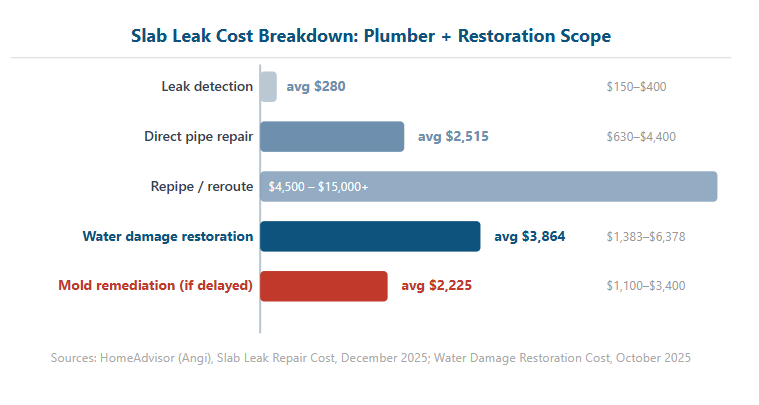
Caption: A slab leak produces two separate invoices: the plumber’s (detection + repair) and the restoration contractor’s (water damage and any mold remediation). Most Texas homeowners insurance policies cover the restoration scope but not the pipe repair. Sources: HomeAdvisor, December 2025 and October 2025.
What drives restoration scope on a DFW slab job:
Detection speed is the largest single variable. A leak caught within 24 hours of onset typically produces a contained drying scope — extraction, equipment deployment, and flooring removal in the affected zone. A leak that ran undetected for five days may require full flooring removal across a much wider area, base plate replacement along affected walls, and mold remediation if the 48-hour biological threshold was crossed.
Flooring type also matters significantly. Hardwood buckles and stains within hours. LVP typically holds longer but fails at the adhesive layer, requiring full removal to dry the concrete beneath. Tile can conceal moisture for longer but may require grout removal to allow the slab to dry to IICRC S500 standard targets.
In DFW, slab restoration jobs commonly involve attic or wall rerouting in post-tension homes, which adds scope compared to a direct interior access repair. Regional labor rates and the specialist equipment required for clay-soil foundation conditions also push DFW project costs above the national average baseline.
To understand the full cost picture by damage category, see our water damage restoration cost guide for DFW. For the timeline of what professional drying involves alongside an active insurance claim, see how long water damage restoration takes in DFW.
Mold Risk Timeline After a Slab Leak in North Texas
The U.S. Environmental Protection Agency states that mold will not grow if wet building materials are dried within 24 to 48 hours of a water event. For slab leaks, that window is more complicated than it sounds. The moisture source is below the floor — invisible and unfelt until flooring adhesive fails or buckling begins — which means the 48-hour clock often started days before the homeowner was aware the leak existed.
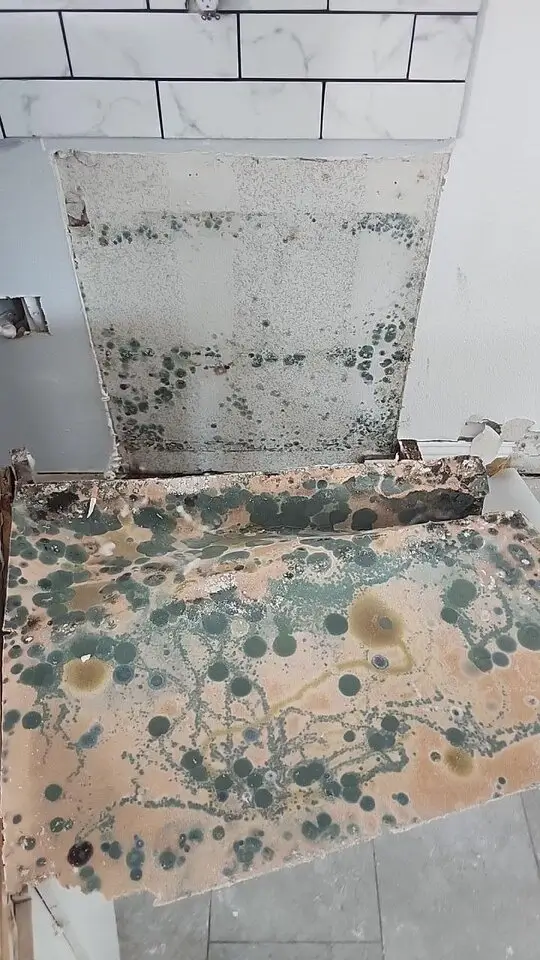
Visible mold-like growth covers exposed wall and floor areas after moisture damage inside a residential room.
Slab leaks are a uniquely high mold-risk scenario for three reasons. First, the moisture source is at the base of the walls, where it saturates the drywall paper facing from the bottom up — the most mold-susceptible surface in a residential wall assembly. Second, the water is often warm (from hot water line leaks), which accelerates biological activity. Third, in DFW summers, the base of an exterior wall sits at high ambient temperature and humidity — conditions where mold establishes faster than the EPA’s general guidance assumes.
Based on EPA guidance and IICRC S520 mold remediation standard research, the biological progression after water exposure follows this pattern in North Texas conditions:
- Hours 0–24: Water saturates the slab and begins wicking upward into flooring adhesive and base plate framing. Mold spores — present naturally in all building environments — begin absorbing moisture. Nothing visible yet.
- Hours 24–48: Spore germination begins. The biological process is active even when surfaces look unchanged.
- Hours 48–72: Visible mold colonies appear on drywall paper and wood base plate material at floor level.
- Days 7–14: Mold penetrates into framing and spreads upward through the wall cavity if moisture continues.
Caption: The EPA’s 24–48 hour mold-prevention window often starts before a slab leak is discovered. By the time flooring buckles or a stain appears, the biological clock may have already run past the point where passive drying is possible. Sources: U.S. EPA; IICRC S520 Standard.
The insurance implication is significant. Once visible mold is confirmed at intake, the water damage claim becomes a mold remediation claim — subject to the $5,000–$25,000 sub-limit most Texas HO-A/HO-B policies carry under TDI Commissioner Order CO-01-1105. An insurer may also argue that the mold resulted from failure to mitigate, rather than the original leak, if there’s evidence the homeowner waited days before calling a restoration contractor.
Stephan Sannikov describes a recent job in McKinney that shows exactly how this plays out. The homeowner confirmed a slab leak on a Thursday, had the plumber fix the pipe Friday, and — thinking the problem was solved — waited until the following Monday to call SS Water Restoration. Over four days, the LVP flooring buckled across 160 square feet, base plates along two walls reached 28% moisture content, and mold was visible in one corner. A scope that would have been roughly $2,800 on day one reached $8,400 by Monday. Insurance covered most of it — but the mold remediation scope pushed against the $10,000 sub-limit. Same pipe failure, four days’ difference, $5,600 more in scope.
SS Water Restoration applies EPA-registered antimicrobial treatment at every slab job on Day 1 — creating a documented record that surfaces were treated before mold could establish, which protects the claim from the mitigation-failure argument. For jobs where mold is already confirmed at intake, see our mold remediation services in DFW.
SS Water Restoration responds within 60 minutes anywhere in DFW — 24 hours a day, 7 days a week. We handle direct insurance billing with Travelers, USAA, State Farm, Safeco, Nationwide, Allstate, and American Family. On every slab leak job, we deploy moisture meters and thermal imaging across the full damage extent, document date-stamped baseline readings that establish sudden onset for your adjuster, and apply EPA-registered antimicrobial treatment on Day 1.
Call (469) 737-0296 — 24/7 DFW Response.
Frequently Asked Questions
Does homeowners insurance cover slab leak water damage in Texas?
Standard Texas HO-A and HO-B homeowners insurance covers sudden and accidental water damage from slab leaks when the pipe failure was unexpected, according to Texas Department of Insurance guidance updated in April 2025. The coverage breaks into distinct categories. The water damage restoration scope — extraction, structural drying, flooring removal, base plate and wall cavity drying, antimicrobial treatment, and reconstruction of damaged finishes — is typically covered under the dwelling coverage provision. Concrete access costs, meaning the expense of jackhammering, tunneling, or perimeter excavation to reach the failed pipe, are covered by most Texas HO-3 policies under “tear-out” provisions — verify this language in your specific declarations page before assuming it applies. The plumbing repair itself is not covered; it is treated as a maintenance expense. Mold remediation is capped at $5,000–$25,000 on most Texas policies under Texas Department of Insurance Commissioner Order CO-01-1105. Many Texas carriers also offer a Foundation Water Coverage endorsement that extends protection to foundation-related water damage — check with your agent whether this appears on your declarations page. For the complete Texas §542 claim process and insurer deadlines, see our water damage insurance claim guide at sswaterrestoration.com/how-to-file-water-damage-insurance-claim-texas/.
How long before a slab leak causes mold in a North Texas home?
The U.S. Environmental Protection Agency states that mold will not grow if wet building materials are dried within 24 to 48 hours of a water event. For slab leaks, the complication is that the moisture source sits directly beneath the floor, where it can saturate base plates and lower wall cavities while remaining completely invisible from above. By the time flooring buckles or a musty smell develops, the EPA’s window may already be closed. Based on EPA guidance and IICRC S520 mold remediation research, visible mold colonies typically appear on drywall paper and wood base plate framing within 48 to 72 hours of sustained moisture exposure. Structural penetration into wall framing can occur within 7 to 14 days. In DFW summers, where morning outdoor humidity averages 82% according to NOAA NWS Fort Worth 1991–2020 climate normals, these timelines compress further — warm, humid conditions accelerate biological activity at floor level. The practical implication: the day you confirm a slab leak is the day you need a restoration contractor on-site, not the day after the plumber leaves. Delaying the restoration call even 48 hours can convert a water damage claim into a mold remediation claim subject to the $5,000–$25,000 sub-limit most Texas policies carry.
What’s the difference between what a plumber and a restoration contractor do after a slab leak?
A plumber and a water damage restoration contractor perform entirely separate scopes of work after a slab leak — and most DFW homeowners call only one, which leaves the job half-finished. The plumber’s scope is to locate the failed pipe using detection equipment, excavate or reroute access to reach it, and repair or replace the line. That work stops when the pipe is fixed and the concrete access point is patched. The restoration contractor’s scope begins where the plumber’s ends: mapping the full moisture extent using thermal imaging and pin-type meters, extracting any standing water, removing flooring materials as needed based on readings rather than visual inspection, establishing and monitoring commercial drying equipment to bring all structural materials to IICRC S500 dry standard targets, applying EPA-registered antimicrobial treatment, and documenting every step with date-stamped readings and photographs for the insurance adjuster. In October 2025, HomeAdvisor reported the national average water damage restoration cost at $3,864, ranging from $1,383 to $6,378 — a separate line item entirely from the plumbing invoice. The correct sequence is: shut off the water, call the plumber, then call the restoration contractor the same day the leak is confirmed.
How do I know if my DFW home has a post-tension slab, and why does it matter?
A post-tension slab has high-tension steel cables embedded in the concrete to resist the soil movement caused by DFW’s expansive clay. In a conventional slab, a plumber can jackhammer through the interior floor to access the pipe beneath. In a post-tension slab, cutting through the interior without a cable location survey risks severing a tensioned cable, which can cause concrete failure and is dangerous. Texas law has required warning placards on post-tension foundations since the late 1990s — look for a metal or plastic tag near the foundation perimeter that reads “POST-TENSION SLAB — DO NOT CUT OR CORE WITHOUT ENGINEERING APPROVAL.” Homes built in DFW by major production builders during the 1980s through the 2000s used post-tension construction extensively. If you have a post-tension slab and can’t find a placard, check the original builder’s plans or call a licensed structural engineer before any slab work begins. In a post-tension home, plumbers must access the pipe from the exterior perimeter by tunneling under the foundation, or reroute the line above-slab through cabinetry or walls. This changes both the repair method and the restoration contractor’s drying protocol, since moisture migration from a perimeter trench differs from moisture migration from an interior floor access point.
How much does slab leak water damage restoration cost in DFW?
Slab leak costs in DFW fall across two separate invoices. The plumbing scope — detection and repair — runs $150–$400 for leak location (average $280) and $630–$4,400 for a direct pipe repair (average $2,280), or $4,500–$15,000 for a full repipe or line reroute, according to HomeAdvisor’s December 2025 cost data. The water damage restoration scope is a separate cost: national average $3,864, ranging from $1,383 to $6,378, according to HomeAdvisor’s October 2025 cost data. In DFW, regional labor rates and the specialized drying requirements of clay-soil slab environments push project costs above the national baseline. Detection speed is the dominant cost variable: a scope caught within 24 hours typically stays contained to the immediate affected zone; a leak that ran undetected for five or more days may require flooring removal across a significantly wider area, base plate replacement, and potentially mold remediation — which adds an average $2,225 (range $1,100–$3,400, HomeAdvisor, October 2025). Most Texas homeowners insurance policies cover the restoration scope; the plumbing repair itself is not covered. For a full breakdown by damage class and category, see our water damage restoration cost guide for DFW.
Conclusion
In DFW, nearly every home sits on a slab — and nearly every slab has copper water lines running through or beneath the concrete that are aging on the same schedule as the clay-soil movement that stresses them every year. Slab leaks aren’t rare events here. They’re a predictable risk in a housing stock built specifically on some of the most expansive soil in the country.
When one happens, the sequence matters more than most homeowners realize. The plumber fixes the pipe. The restoration contractor addresses the water. Texas homeowners insurance covers the restoration scope and often the concrete access — but not the pipe, and not mold above the policy sub-limit if the response was delayed. The day the leak is confirmed is the day both contractors need to be called.
- Understand what restoration involves alongside your claim: water damage restoration timeline for DFW
- See the full cost breakdown by damage class: water damage restoration costs in DFW
- Call [(469) 737-0296](tel:4697370296) — 60-minute response, 24/7, anywhere in DFW
Sources
1. NAHB / Eye on Housing, “Foundation Types in 2024: Slabs Continue to Rise, Crawl Spaces Decline,” August 2025, https://eyeonhousing.org/2025/08/foundation-types-in-2024-slabs-continue-to-rise-crawl-spaces-decline/
2. U.S. Environmental Protection Agency, “A Brief Guide to Mold, Moisture and Your Home,” retrieved 2026-05-30, https://www.epa.gov/mold/brief-guide-mold-moisture-and-your-home
3. Texas Department of Insurance, “When Are Water Damage and Mold Covered by Insurance?” April 2025, https://www.tdi.texas.gov/tips/when-are-water-damage-and-mold-covered-by-insurance.html
4. Texas Department of Insurance, Commissioner Order CO-01-1105, “Mold Endorsements,” retrieved 2026-05-30, https://www.tdi.texas.gov/orders/co-01-1105.html
5. HomeAdvisor (Angi), “What Does Slab Leak Repair Cost?” December 2025, https://www.homeadvisor.com/cost/plumbing/slab-leak-repair/
6. HomeAdvisor (Angi), “How Much Does Water Damage Restoration Cost?” October 2025, https://www.homeadvisor.com/cost/disaster-recovery/repair-water-damage/
7. Insurify (citing Insurance Information Institute), “Water Damage Statistics: Exploring Costs and Insurance Claims,” October 2025, https://insurify.com/homeowners-insurance/insights/water-damage-statistics/
8. Geology.com, “Expansive Soil,” citing USGS Swelling Clays Map I-1940 (Olive et al., 1989) and ASCE expansive soil research, https://geology.com/articles/expansive-soil.shtml
9. NOAA National Weather Service Fort Worth, “DFW Climate Records and Normals,” 1991–2020 30-Year Climate Normals, https://www.weather.gov/fwd/dfwrecordsnormals
10. IICRC S520 Standard for Professional Mold Remediation, current edition, https://www.iicrc.org/
11. IICRC S500 Standard for Professional Water Damage Restoration, current edition, https://www.iicrc.org/